Property Management Accounts Payable: Process, Controls and Owner Money
Property management accounts payable explained: the 5-step process, what every property invoice needs, utility bills, trust accounts, 1099s and the controls that protect owners.
Quick answer
Property management accounts payable is paying the bills for the properties you manage, such as repairs, utilities, landscaping and insurance, from the right property's money. It works like normal AP with three extra rules: every invoice must be coded to a property (and often a unit), payments must respect each owner's spending limit and come from that property's bank or trust account, and every bill must show up correctly on the owner statement. Most problems start with invoice data that is missing the property, unit or work order.
Why listen to us: ECIT Digital reads supplier invoices for property and finance teams every day and delivers the checked data into their property management and ERP systems.
Somewhere in your portfolio, a water heater is plotting. It will fail on a Friday night, a plumber will fix it, and three weeks later an invoice will arrive that says "418 Cedar" and nothing else [I cannot keep track of the warranty on my own kettle, so I respect your struggle].
This guide covers what makes property AP different, the five-step process, the data every invoice needs, utility bills, trust accounts, 1099 season, and the controls that stop the wrong owner paying for that water heater. It is about paying bills, not collecting rent [rent is a whole other guide, and a whole other headache].
On this page
- What makes property management AP different
- The property management AP process, step by step
- What every property invoice must tell you
- Utility bills: the quiet volume problem
- Trust accounts and owner money
- Vendors: W-9s, insurance and 1099 season
- Controls and common mistakes
- Clean invoice data into your property system
| Area | Standard company AP | Property management AP |
|---|---|---|
| Whose money | The company's own | Each owner's, held per property |
| Coding | GL account and cost center | Property, unit and GL account |
| Approval | Internal approval limits | Internal limits plus each owner's spending limit |
| Bank accounts | One or a few | Often one per property or owner, sometimes trust accounts |
| Reporting | Internal management reports | Owner statements, often monthly |
| Typical bills | Suppliers and services | Repairs, utilities, landscaping, cleaning, insurance, HOA fees |
Summary of common practice for US property managers. Your management agreements set the exact rules.
What makes property management AP different
In normal accounts payable, a company pays its own bills. In property management, you pay other people's bills with other people's money, and then you send them a report about it [no pressure; they will read every line].
That one twist changes everything. Each invoice has to land on the right property, get paid from the right account, stay inside the owner's limit, and show up on the right statement. Get any of those wrong and an owner is paying for a stranger's water heater [and they will notice, because owners read statements the way I read restaurant bills].
The basics still apply, so if you want the general version first, read our guide to the accounts payable process. This guide is the property edition [same recipe, extra hot sauce].
The property management AP process, step by step
Five steps, and every one of them needs to know which property the bill belongs to. Miss it at step one and steps two to five confidently do the wrong thing [like a GPS with the wrong address and a very calm voice].
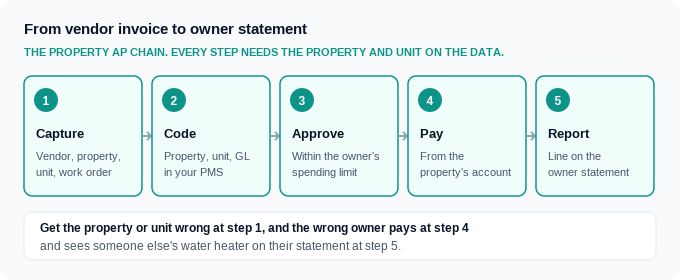
- Capture. Get every invoice into one place and read the vendor, property, unit, work order, amount and due date. Invoices arrive by email, vendor portal and, yes, the mail [some plumbers still mail paper, and I find that weirdly charming].
- Code. Assign the property, unit and GL account in your property management system, such as repairs, utilities or landscaping.
- Approve. Check the amount against your internal limits and the owner's spending limit in the management agreement. Over the limit means asking the owner first.
- Pay. Pay from that property's or owner's bank account, on your normal payment run, before the due date.
- Report. The bill appears on the owner statement with enough detail that the owner does not call you [the dream].
For the approval step in more detail, see our guide to the invoice approval workflow. For coding, see invoice coding [both written by me, both mercifully shorter than a lease].
What every property invoice must tell you
A vendor invoice for a property needs more than a vendor and a total. It needs to say where the work happened and who asked for it [otherwise it is just a very confident request for money].
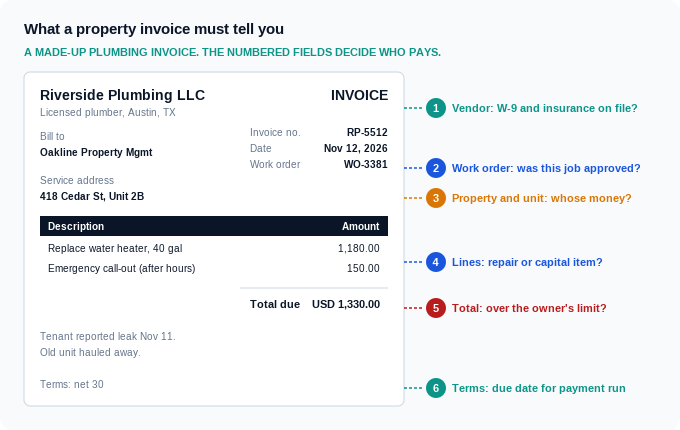
The service address and unit decide whose money pays. The work order proves someone approved the job before it happened, which matters a lot when the plumber "noticed a few other things while he was there" [he always notices a few other things].
The lines matter too. A new water heater may be a capital improvement rather than a repair, depending on your policy and the owner's accountant, so it may need a different GL account [the water heater, still causing trouble from beyond the grave]. Tell vendors exactly what you need on every invoice, put it in your vendor onboarding, and send back invoices that miss it.
Utility bills: the quiet volume problem
Repairs are dramatic. Utility bills are boring, constant and everywhere: water, electricity, gas, trash and sewer, for every property, every month [they never call in sick, and neither can you].
| Utility problem | What goes wrong | What helps |
|---|---|---|
| Account number, not property name | The bill is hard to match to a property | Keep a list of every utility account number and its property and unit |
| Vacant units | The owner pays utilities that should move to a new tenant | Check move-in and move-out dates before paying |
| Usage spikes | A leak or a broken meter goes unnoticed | Compare each bill with the same month last year |
| Missed bills | Late fees, or service shut off | Track which bills are expected each month and chase missing ones |
The trick is to read the account number and service address off every bill, every time, and match it to your list [a spreadsheet nobody loves, and everybody needs]. A usage spike is often the first sign of a running toilet, which costs real money while it sings to itself in an empty unit.
Trust accounts and owner money
In many states, money you hold for owners and tenants is trust money, and it has rules. You cannot mix it with your own company's money, and you cannot pay one owner's bills with another owner's cash [not even "just until Friday"].
California's real estate regulator is a good example of how strict this is. Its trust funds guide says: "Funds belonging to a licensee may not be commingled with trust funds. Commingling is strictly prohibited by the Real Estate Law." It is grounds for losing your license there [the most expensive way to borrow from Peter to pay Paul].
For AP, that means each bill must be paid from the account that belongs to the right property or owner, and your records must show it. Rules differ by state, so check your state's real estate regulator and your own attorney [I am a person who writes blog posts, not your lawyer, as my mother likes to remind me].
Vendors: W-9s, insurance and 1099 season
Every vendor that works on a property should be set up properly before the first payment. Three documents do most of the work [paperwork, the property manager's true love language].
| Document | Why you need it | Source |
|---|---|---|
| Form W-9 | The vendor's taxpayer ID, which you need for 1099 reporting | IRS |
| Certificate of insurance | Proof of liability insurance, and its expiration date, before work starts on site | Your management agreement and your insurer |
| Form 1099-NEC | Reports payments to non-corporate vendors of $2,000 or more, for tax years beginning after 2025. Due to the vendor and the IRS by January 31 | IRS |
Two details catch property managers out. Payments to corporations are generally exempt from 1099 reporting, but the IRS says "you must report attorneys' fees", even to corporations [lawyers, as usual, get special treatment]. And if you pay vendors on an owner's behalf, the IRS says "you may be responsible for filing Form 1099-NEC" when you "perform management or oversight functions in connection with the payment". Ask your tax adviser who files for each owner, and write it down.
Collect the W-9 and insurance certificate when you add the vendor, not in January when 1099 season arrives and the handyman has changed his phone number [he always changes his phone number in January].
Controls and common mistakes
Property AP has the same risks as any AP team, plus a few of its own. Here are the ones that cause the most owner phone calls [ranked by how loud the owner is].
| Mistake | Control that prevents it |
|---|---|
| Bill coded to the wrong property or unit | Read the service address and unit off every invoice, and require a work order |
| Paying over the owner's limit without asking | Check each bill against the limit in the management agreement |
| Paying the same invoice twice | Duplicate check on vendor, invoice number and amount before payment |
| Paying from the wrong bank account | One bank account per property or owner in your system, checked at payment |
| Fake or changed vendor bank details | Call the vendor on a number you already have before changing details |
| Vendor with no insurance working on site | No new jobs until a current certificate is on file |
Two of these have their own guides: invoice fraud for the fake bank details, and accounts payable internal controls for the rest [I am contractually obliged to link my own work; nobody else will].
And close every month the same way: compare what you paid with what each owner statement shows, before the statements go out. It is much easier to fix a water heater on a draft than on a statement the owner has already read twice [and screenshotted, and sent to their cousin who "knows about plumbing"].
Clean invoice data into your property system
We do the first step, capture, and we do it so your team never has to open an invoice. We do not code, approve or pay bills [I am not trusted with the water heater, and honestly, fair].

- The fields property AP needs. Our AI reads the vendor, invoice number, service address, unit, work order, line items, totals and any other field you ask for, from PDF, email or paper. Paper is scanned by our partners.
- Checked by people. Our team validates every field the AI is unsure about, with 99.8% accuracy guaranteed.
- Into your property management system. We deliver the data by API into your property management system, ERP or AP tool, where your coding, approvals and payments run. Our team handles the setup and the connection.
- Pay per document. No expensive license.
See how it works on our AP automation and PDF to electronic invoice pages, or read how the capture step works in our guide to invoice data extraction.
Want to see how your invoice process scores today? Run the free invoice health check: it scores your invoice process in about 3 minutes and estimates what you could save, based on your own numbers.
Every invoice to the right property
Vendor invoices read, checked and delivered into your property system
AI capture plus human validation, with 99.8% accuracy guaranteed. You pay per document, with no license.
So: get the property and unit on every invoice, respect each owner's limit, pay from the right account, and check the statements before they go out. The water heater will still fail on a Friday night, but at least the right owner will pay for it [and I will still not know where my kettle warranty is].
Sondre Bratlandsmo
November 25, 2026
Book free live demo
Learn how the ECIT Digital solutions can help you with the help from one of our experts.


Frequently asked questions
Property management accounts payable is paying the bills for the properties a company manages, such as repairs, utilities, landscaping and insurance. Each bill is coded to a property and often a unit, approved within the owner's spending limit, paid from that property's or owner's account, and reported on the owner statement.
A property manager pays bills with owners' money, not its own. That adds coding by property and unit, owner spending limits set in the management agreement, separate bank or trust accounts per property or owner, and owner statements that show every bill.
Besides the vendor, invoice number, date and amount, it should include the service address and unit, the work order number, a clear description of the work on each line, and the payment terms. Without the property and unit, the bill cannot be charged to the right owner.
No. Money held for owners is usually trust money, and state rules generally require it to be kept separate from the manager's own funds and accounted for by owner. Each bill should be paid from the account that belongs to the right property or owner. Check your state's rules with your attorney.
It depends on who is the payor. The IRS says a person paying on behalf of another may be responsible for filing Form 1099-NEC when they perform management or oversight functions in connection with the payment. For tax years beginning after 2025, the reporting threshold is $2,000. Confirm the setup with your tax adviser.
Capture the service address, unit and work order from every invoice, keep a list of utility account numbers by property, set up one bank account per property or owner in your system, and compare payments with each owner statement before the statements go out.
Relevant articles
Duplicate Invoices: How They Slip In and How to Detect Them
Invoice Data Extraction: Fields, Line Items and Accuracy Checks