Invoice Fraud: 6 Types, Red Flags and How to Detect It
Invoice fraud explained: the 6 types, the red flags, detection rules with starting settings, prevention controls, and what to do in the first hours if you paid.
Quick answer
Invoice fraud is any attempt to get a business to pay an invoice it does not owe: a fake supplier, a real supplier's invoice with changed bank details, an inflated or duplicate bill, or a bill for something never ordered. It is detected with red flags and rules (new bank details, near-duplicate invoice numbers, no purchase order) and prevented with segregation of duties, callback checks on a known phone number, and matching invoices to purchase orders and receipts.
Why listen to us: ECIT Digital reads supplier invoices for finance teams every day and delivers the checked data into the ERP or AP tool where their fraud controls run.
Invoice fraud is a confident stranger with a clipboard. Nobody stops a person in a hi-vis vest with a clipboard, and nobody questions an invoice with a logo on it [I once walked into a hotel kitchen just by carrying a tray; I was looking for the bathroom, I am not proud].
This guide shows you the six ways the stranger gets in, the red flags, the detection rules, and what to do in the first hours if you already paid. It is part of our guide to accounts payable internal controls [the bit where we check the clipboard].
| Type | Who usually does it | Red flag | Control that catches it |
|---|---|---|---|
| Changed bank details | Outside fraudster posing as a supplier | An email asking you to pay a new account | Callback on a number already on file |
| Fake supplier | Insider or outsider | A supplier nobody in the business asked for | Verified supplier setup, segregation of duties |
| Inflated invoice | Real supplier | Prices or quantities above the purchase order | Matching with tolerances |
| Work never done | Real or fake supplier | No goods receipt or sign-off | Three-way matching, approval |
| Duplicate invoice | Supplier, or an honest mistake | Same amount, slightly different invoice number | Duplicate check before payment |
| Unordered bill | Outside scammer | A bill for a listing or supplies you never ordered | No PO, no payment until checked |
Summary of common practice in US AP teams.
What is invoice fraud?
Invoice fraud is getting a business to pay money it does not owe by using an invoice as the disguise. The invoice can be completely fake, a real one with one detail changed, or a real one sent twice [the clipboard can be stolen, forged or photocopied].
It is common, and it comes from both outside and inside the business. Here are the numbers from the people who count them [I counted once; I got a different number every time]:
| Finding | Figure | Source |
|---|---|---|
| US organizations hit by attempted or actual payments fraud in 2025 | 76% | AFP, 2026 |
| US organizations affected by business email compromise in 2025 | 74% | AFP, 2026 |
| Reported business email compromise losses in 2025 | $3,046,598,558 from 24,768 complaints | FBI IC3, 2025 |
| Insider fraud cases that involved billing schemes | 21%, median loss $90,000 | ACFE, 2026 |
| Median time before a billing scheme is caught | 14 months | ACFE, 2026 |
Three out of four organizations is about my success rate at finding the right Zoom link [and I have one meeting a day]. And 14 months is longer than my last diet, which was also fraud.
The 6 types of invoice fraud
Six ways in, each with a different clipboard [the stranger owns several].
1. Changed bank details
A real supplier "updates" their bank account by email, and the new account belongs to a fraudster. This is business email compromise, and it is the most expensive clipboard of the lot [the stranger did not even have to stand up].

2. Fake supplier
A supplier that does not exist bills you for goods that never arrive. The insider version is someone in your team setting up the supplier and approving its invoices [the stranger with a clipboard turns out to be Gary from accounts].
3. Inflated or padded invoice
A real supplier bills more than agreed: a higher price, extra units, or a "handling fee" nobody discussed. It looks real because the supplier is real [the clipboard is genuine; the numbers on it are fan fiction].
4. Work never done
An invoice for services or goods that never happened. Services are the easy target because there is no box to count [you cannot do a goods receipt for "strategic consulting"].
5. Duplicate invoice
The same invoice sent twice, often with a tiny change like INV-1001 and INV1001. Sometimes it is fraud, sometimes just messy billing [either way, paying twice is not a love language].
6. Unordered bills and fake listings
The FTC warns that "Scammers create phony invoices that look like you ordered products or services for your business", often for a "listing in a phony business directory" [a directory nobody has opened since the fax machine].
If a package of supplies you never ordered turns up, the FTC says "you have a legal right to keep it and use it for free". Its advice on the bill is two words: "Don't pay." [the shortest and best financial advice I have ever read].
Invoice fraud red flags
Most fake invoices give themselves away if someone actually looks. Here are the signs your team should be trained to spot [print it, laminate it, stick it next to the coffee machine where people actually read things].
| Red flag | What it looks like |
|---|---|
| New bank details | By email, "effective immediately" |
| Urgency or secrecy | "Pay today", "the CEO approved it", "don't call" |
| An email address that is almost right | One letter off, or a free mail domain |
| No purchase order | From a supplier who always used one |
| Odd invoice number | Out of sequence, or almost identical to a paid one |
| Suspicious amount | Round, or just under an approval limit, like $4,990 |
| New supplier, fast payment | Paid within days of being set up |
| Supplier matches an employee | Same address or bank account |
One red flag is a question, not a verdict. Three red flags on one invoice is the clipboard stranger asking for the safe combination [call someone].
Invoice fraud detection: rules that work
Invoice fraud detection means turning those red flags into rules your AP tool or a monthly report checks every time. People get tired and computers do not [computers also do not take Fridays off mentally, unlike me].
| Detection rule | What it catches | A common starting setting |
|---|---|---|
| Same supplier, same amount, close dates | Duplicates | Within 30 to 60 days |
| Near-duplicate invoice numbers | Resubmitted invoices | Ignore dashes, spaces and leading zeros when comparing |
| Bank details changed, then paid | Changed bank details fraud | Hold the first payment until a callback is logged |
| New supplier, fast payment | Fake suppliers | Review any supplier paid within 30 days of setup |
| Amount just under a limit | Split invoices | Within 5% below each approval limit |
| Supplier matches an employee | Insider schemes | Compare bank accounts and addresses with payroll |
| No PO, no receipt | Work never done | Route every non-PO invoice to the budget owner |
Practitioner starting points, not official thresholds. Tune them to your own invoice volumes.
Expect false alarms at first. A rule that flags every invoice gets ignored by week two [like my smoke alarm, which goes off for toast]. Start strict on bank changes and new suppliers, then loosen the rest once you see what it finds.
Do not forget people. The ACFE says 43% of frauds in its 2026 study were detected after a tip [the receptionist noticed the clipboard was upside down]. A simple way to report a worry is a detection tool too.
Invoice fraud prevention: the controls
Detection catches the stranger inside the building. Prevention is locking the door [cheaper, and nobody has to chase anyone down a corridor].
| Control | What it means |
|---|---|
| Call back on every bank change | Phone the supplier on a number already on file. The FBI: "Contact vendors through telephone numbers on file rather than through a number provided in emails." |
| Split the duties | The person who adds a supplier does not approve its invoices or release the payment |
| Lock the vendor master | Few people can edit supplier bank details, and every change is logged and reviewed |
| Match before you pay | Compare the invoice to the purchase order and goods receipt, within tolerance |
| Approve with limits | A written approval matrix, with nobody approving their own spending |
| Validate the invoice data | Check the supplier, tax details and totals before the invoice moves on |
Each control has its own guide: three-way matching, the invoice approval workflow and invoice validation [I wrote them all, and yes, my family is worried]. The FTC's advice for small businesses fits on a sticky note: "Make sure procedures are clear for approving purchases and invoices and ask your staff to check all invoices closely."
Your bank's rules are tightening too. Nacha's fraud monitoring rules, which began on 20 March 2026, require businesses that send ACH payments to have risk-based checks for payments made because of fraud, including vendor impersonation [the clipboard stranger is now officially a compliance topic].
Paid a fake invoice? The first hours
If the money already left, speed matters more than blame. The FBI says "If you discover a fraudulent transfer, time is of the essence." [this is not the moment for a meeting about the meeting].
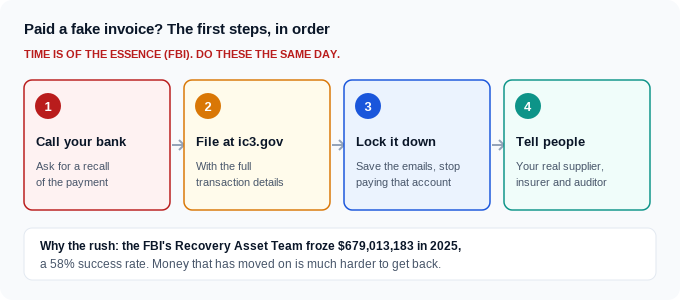
Call your bank first and ask for a recall. The FBI tells victims to "contact your financial institution and request a recall of the funds", then file at ic3.gov with the full transaction details [the bank before the boss, I promise the boss will understand].
Money does come back sometimes. In 2025, the FBI's Recovery Asset Team worked 3,900 incidents and froze $679,013,183, a 58% success rate [58% is not great odds, but it beats my odds at karaoke]. Then save every email, stop any other payments to that account, and tell your real supplier, your insurer and your auditor. Whether you are reimbursed depends on your bank agreement and your insurance policy, so ask both the same day.
Fraud hides in bad data
Every rule above compares invoice data: supplier, invoice number, amount, bank details. If that data was typed in wrong, the rules check the wrong thing and the stranger walks straight past [a guard checking the wrong clipboard is just a person standing in a corridor].

We do not approve or pay invoices, and we are not a fraud tool. ECIT Digital sits at the front door, so the data your controls check is the data on the invoice:
- Every field you need. Our AI reads the supplier, invoice number, PO number, line items, tax and any other field you ask for, whether the invoice arrives as PDF or paper.
- Checked by people. Our team reviews what the AI is unsure about, with 99.8% accuracy guaranteed.
- Into your system. We deliver the data into your ERP or AP tool by API, where your matching, approvals and duplicate checks run.
See how it works on our invoice processing services and PDF to electronic invoice pages, or see how matching works in our purchase order matching use case.
Want to see how ready your invoice process is today? Run the free invoice health check: it scores your invoice process in about 3 minutes and estimates what you could save, based on your own numbers.
Clean data at the front door
Every invoice read and checked before your controls run
AI capture plus human validation, with 99.8% accuracy guaranteed. You pay per document, with no license.
So: call back on bank changes, split the jobs, match before you pay, and write the red flags on the wall. The stranger with the clipboard is very confident, but confidence is not a purchase order [and I still have not found that bathroom].
Sondre Bratlandsmo
November 24, 2026
Book free live demo
Learn how the ECIT Digital solutions can help you with the help from one of our experts.


Frequently asked questions
Invoice fraud is any attempt to get a business to pay an invoice it does not owe. Common forms are an email changing a real supplier's bank details, a fake supplier, an inflated or duplicate invoice, a bill for work never done, and a bill for something never ordered.
The most common example is an email that looks like it comes from a real supplier, saying their bank account has changed and asking you to pay the next invoice to the new account. The new account belongs to a fraudster. Calling the supplier on a phone number already on file stops it.
Very common. The AFP's 2026 Payments Fraud and Control Survey found 76% of US organizations faced attempted or actual payments fraud in 2025, and 74% were affected by business email compromise. The FBI recorded $3,046,598,558 in business email compromise losses in 2025.
Sometimes. Contact your bank at once and ask for a recall of the payment, then file a complaint at ic3.gov with the full transaction details. In 2025 the FBI's Recovery Asset Team froze $679,013,183 with a 58% success rate. Whether you are reimbursed depends on your bank agreement and your insurance policy.
If money was sent, tell your bank first, then file a complaint with the FBI at ic3.gov. Fake invoices and other scams can also be reported to the FTC at ReportFraud.ftc.gov.
No. The FTC's advice on bills for products or services you did not order is "Don't pay." It also says that if you receive merchandise you did not order, you have a legal right to keep it and use it for free.
Relevant articles
Invoice Approval Workflow: Approval Matrix, Routing and Audit Proof
Invoice Coding: What GL Coding Is, Who Does It, and How to Fix Mistakes