Invoice Validation: What to Check Before You Pay, and Who Checks It
An invoice validation checklist with pass and fail rules, which checks to automate and which need a person, and how e-invoice validation works.
Quick answer
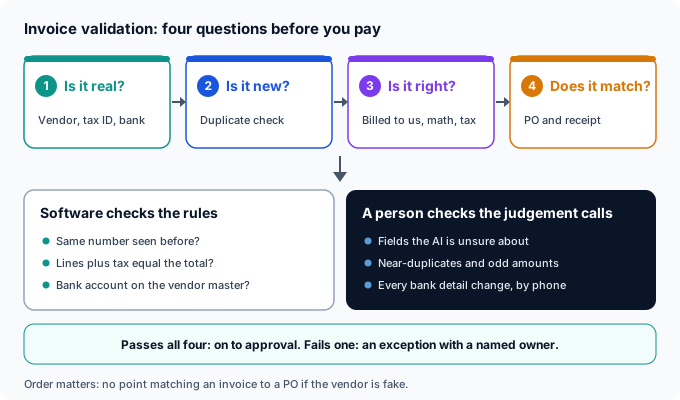
Invoice validation is the set of checks accounts payable runs on an invoice before it is approved and paid. It answers four questions: is the vendor real (tax ID, bank details), is the invoice new (no duplicate), is it right (billed to your company, math and tax add up), and does it match what you ordered and received. Software handles the rule checks, a person handles the judgement calls, and any invoice that fails a check becomes an exception with a named owner.
Why listen to us: ECIT Digital validates supplier invoice data for finance teams every day. Our AI reads every invoice, our people check what the AI is unsure about, and we guarantee 99.8% accuracy on the data we deliver.
Last winter I paid a "final reminder" from my energy company within ten minutes of opening it. Then the real bill arrived [the first one was from a company that does not exist, which explains the very relaxed spelling].
I skipped every check in this guide. I did not ask whether the sender was real, whether I had already paid, or whether the bank details matched my last bill. AP teams get hundreds of these a week, so this guide gives you the checklist I should have used [my bank still calls me "the customer with the energy situation"].
Validation is one of the core accounts payable internal controls, and the first one most invoices meet.
The invoice validation checklist
Here is the whole checklist, with what counts as a pass. Print it, laminate it, stick it next to whoever pays the bills [or next to me, I need it more].
| Check | Passes when | If it fails |
|---|---|---|
| Vendor exists | Name and tax ID match an approved vendor | Hold until the vendor is set up and verified |
| Bank details | Account matches the vendor master | Hold and call the vendor on a number already on file |
| Not a duplicate | No earlier invoice with the same vendor, number and amount | Block and check with the vendor |
| Billed to us | Your legal entity name and address are on it | Return for a corrected invoice |
| Required fields | Invoice number, date, description, tax and total are present | Return for a corrected invoice |
| Math adds up | Lines plus tax equal the total | Ask for a corrected invoice or credit note |
| Tax is right | Rate and tax ID valid for this supply | Send to tax or the controller |
| Matches the PO | Price and quantity within your tolerance | Send to the buyer |
| Goods received | A goods receipt covers the invoiced quantity | Hold until receiving confirms |
What is invoice validation?
Invoice validation means checking that an invoice is genuine, complete, correct and expected before anyone approves it. It sits between capturing the invoice data and approving the payment in the accounts payable invoice processing steps [after the reading, before the paying, ideally before the panicking].
People mix it up with three neighbors, so here is the difference in one table.
| Term | The question it answers |
|---|---|
| Validation | Is this a genuine, correct invoice we have not seen before? |
| Matching | Does it agree with the PO and goods receipt? |
| Approval | Does the budget owner accept the spend? |
| Verification | Often used for the same thing as validation; some teams use it for checking with the vendor directly |
1. Is the vendor real?
Start with the sender, because every later check is wasted on a fake vendor. Check the name and tax ID against your approved vendor list, and check the bank details against the vendor master [my energy "company" would have failed in about four seconds].
Government tools make the tax ID part easy. In the UK, HMRC's check a UK VAT number service confirms "if a UK VAT registration number is valid" and the business it is registered to. For EU suppliers, the EU's VIES tool lets you "check if a business is registered to trade cross-border within the EU" [the government, finally doing some of the work for us].
In the US, the IRS TIN Matching service "lets you validate TIN and name combinations before submitting an information return", for payers registered to use it. Collect the vendor's W-9 at setup, then match it [chasing W-9s in January is nobody's favorite winter sport].
Bank details deserve the most care. The FBI's guidance on business email compromise is to "Use secondary channels or two-factor authentication to verify requests for changes in account information." In plain words: call the vendor on a number you already had [not the number in the email, which goes straight to the fraudster's very helpful cousin].
2. Is the invoice new?
A duplicate check looks for an earlier invoice from the same vendor with the same number, date and amount. The trouble is that duplicates rarely look identical [mine had a different logo and the same smugness].
| Duplicate rule | What it catches |
|---|---|
| Exact: same vendor, number and amount | The same PDF sent twice |
| Normalized number: ignore dashes, spaces and leading zeros | INV-0045 keyed once as INV45 |
| Same vendor, same amount, close dates | A copy with a new number |
| Same amount, same bank account, different vendor name | One supplier set up twice |
Exact matches can be blocked automatically. The fuzzier rules should flag an invoice for a person rather than block it, because some vendors really do bill the same amount every month.
3. Is it right?
This check asks whether the invoice is addressed to you, complete and correct. Your legal entity name should be on it, the lines plus tax should equal the total, and the tax should be right for what you bought [a surprising number of invoices cannot add up their own totals].
For UK VAT, HMRC lists the details a VAT invoice must show, and notes that "Your customers need VAT invoices as evidence for reclaiming, as input tax, the VAT you have charged them." No valid VAT invoice, no VAT reclaim, so a missing VAT number is worth a polite email back.
4. Does it match?
For PO invoices, the last check compares price and quantity with the purchase order and the goods receipt. Small differences are normal, so set tolerances and write them down [otherwise every 40-cent rounding difference becomes a meeting].
| Difference | Tolerance | What happens |
|---|---|---|
| Price per unit | Within 2% or $10 per line, whichever is lower | Passes |
| Quantity | No more than received | Passes if covered by a goods receipt |
| Anything above tolerance | None | Exception to the buyer |
A fictional policy, to show the method. Set tolerances that fit your spend.
Non-PO invoices skip the match and go to the budget owner to confirm. Our guide to invoice matching covers 2-way and 3-way matching in detail.
Which checks software should do, and which need a person
Software is brilliant at rules and hopeless at suspicion. A person is the opposite, especially before coffee [I am a person, I can confirm the coffee part].
| Let software do it | Keep a person on it |
|---|---|
| Exact duplicate blocking | Near-duplicates and odd amounts |
| Lines plus tax equal the total | Fields the capture tool is unsure about |
| Bank account matches the vendor master | Every bank detail change, verified by phone |
| Price and quantity within tolerance | Anything outside tolerance |
| Required fields present | New vendors and first invoices |
The rule of thumb: automate the checks with a clear right answer, and route the rest to someone who can pick up the phone.
Validation done for you
ECIT Digital reads every invoice with AI, our team checks every field the AI is unsure about, and validated data goes into your ERP or AP tool with 99.8% accuracy guaranteed. See our invoice processing services.
E-invoice validation: checking the file, not just the facts
E-invoices add a second kind of validation: checking that the file itself follows the standard. In Europe that standard is EN 16931, which the European Commission says "defines a core invoice data model that contains information commonly used in invoices" [a dress code, but for data].
The Commission adds that "This exact compliance is necessary for the buyer to automatically receive and process the invoice". PEPPOL's invoice format follows the same standard: Peppol BIS Billing 3.0 is "a Core Invoice Usage Specification (CIUS) based on CEN/EN 16931:2017."
A file can pass every format rule and still be a fake bill from a fake vendor [fraudsters can follow a dress code too]. So an e-invoice still goes through the four business checks above. Read more in what an e-invoice is and how our PEPPOL e-invoicing works.
What happens when invoice validation fails
A failed check should never mean an invoice sits in someone's inbox. It becomes an exception with an owner and a deadline [the energy company never gave me a deadline, which in hindsight was a clue].
| Failed check | Owner | Fix within |
|---|---|---|
| Unknown vendor or new bank details | Vendor master owner | Before any payment |
| Possible duplicate | AP | Before the next payment run |
| Wrong entity, missing fields, bad math | AP, with the vendor | 5 working days |
| Outside PO tolerance | Buyer | 5 working days |
| No goods receipt | Receiving or the requester | 3 working days |
A fictional policy, to show the method. Set deadlines that leave room before the due date.
Track how many invoices fail and why. If one vendor fails every month, the fix is a conversation with that vendor, not more checks.
What we see in the field
Validation is the step our team does for clients every day, so we see the same patterns over and over [like a lifeguard who only ever rescues the same three swimmers].

- Many failures start as reading errors. A misread invoice number hides a duplicate, and a misread total looks like a matching problem.
- People check what the AI is unsure about. Our AI reads every field, and anything it is not confident about goes to someone on our team before delivery. That is how the 99.8% accuracy guarantee holds.
- Clients never touch the document. Validated data lands in their ERP or AP tool, and their team keeps approvals and payments.
- Line items matter. Validating only the header leaves the PO match to be done by hand.
"Construction invoices are complex and highly variable and ECIT provided a flexible and extensible data extraction model that worked wonderfully." - Terence Pua, CEO, Hinges AI
Want to see how your own invoice checks stack up? Run the free invoice health check: it scores your invoice process in about 3 minutes and estimates what you could save, based on your own numbers.
Validated invoice data, done for you
Invoices in, clean data out, 99.8% accuracy guaranteed
Our AI reads every invoice, our team checks what the AI is unsure about, and validated data goes straight into your ERP or AP tool. You pay per document, with no license.
As for my energy "company": I now check every bill against the last one, and I call the number on the old bill before paying anything new [my bank has stopped calling, which I choose to see as trust]. Four questions, every invoice. It works for a kitchen table, and it works for an AP team.
Sondre Bratlandsmo
November 20, 2026
Book free live demo
Learn how the ECIT Digital solutions can help you with the help from one of our experts.


Frequently asked questions
Invoice validation is the set of checks accounts payable runs on an invoice before it is approved and paid. It confirms that the vendor is real, the invoice is not a duplicate, the invoice is billed to your company with correct math and tax, and it matches the purchase order and goods receipt where there is one.
An invoice validation checklist should cover: the vendor exists and its tax ID matches, bank details match the vendor master, the invoice is not a duplicate, it is billed to your legal entity, required fields are present, lines plus tax equal the total, the tax is right, the price and quantity match the PO within tolerance, and a goods receipt covers the invoiced quantity.
Invoice validation checks that an invoice is genuine, complete, correct and not a duplicate. Invoice matching is one part of that work for PO invoices: it compares the invoice with the purchase order (2-way match) and the goods receipt (3-way match) to confirm you ordered and received what you are being billed for.
In the UK, use HMRC's check a UK VAT number service on gov.uk, which confirms whether the number is valid and which business it is registered to. For EU suppliers, use the EU's VIES tool. In the US, collect a Form W-9 when you set up the vendor, and registered payers can use the IRS TIN Matching service to check the name and TIN combination.
Checks with a clear right answer can be automated: exact duplicate blocking, lines plus tax equal to the total, bank account matching the vendor master, required fields present, and price and quantity within tolerance. Judgement calls should go to a person: near-duplicates, unusual amounts, fields the capture tool is unsure about, new vendors and every bank detail change, which should be verified by phone.
E-invoice validation checks that an electronic invoice file follows the required standard, so the buyer's system can process it automatically. In Europe that standard is EN 16931, and Peppol BIS Billing 3.0 is based on it. A valid file can still be a fake or wrong invoice, so e-invoices also need the usual business checks on vendor, duplicates, amounts and the purchase order.
Relevant articles
Accounts Payable Internal Controls: The Checks That Stop Fraud and Errors
Accounts Payable Invoice Processing: 8 Steps from Inbox to Payment