Accounts Payable Internal Controls: The Checks That Stop Fraud and Errors
The accounts payable internal controls that matter, from segregation of duties to vendor master data, plus a starter set for small teams that cannot split duties.
Quick answer
Accounts payable internal controls are the rules and checks that make sure you only pay real vendors, for goods and services you actually received, the right amount, once. The core controls are segregation of duties, vendor master data controls, invoice validation, three-way matching, duplicate invoice checks, approval limits, verified payment release and monthly reconciliation. Small teams that cannot split every duty add a monthly review by someone outside AP instead.
Why listen to us: ECIT Digital processes supplier invoices for finance teams every day. Our AI reads every invoice, our people check what the AI is unsure about, and we guarantee 99.8% accuracy on the data we deliver.
For three years I was treasurer of my five-a-side football team. I collected the money, paid for the pitch and kept the books, all by myself [you can already see the audit finding].
One month the numbers did not add up, and the only suspect was me. I was innocent, just bad at spreadsheets, but I could not prove it. That is the problem internal controls solve. This guide covers the AP controls that matter most, including what to do when your team is too small to split the work [the football team has since fired me, lovingly].
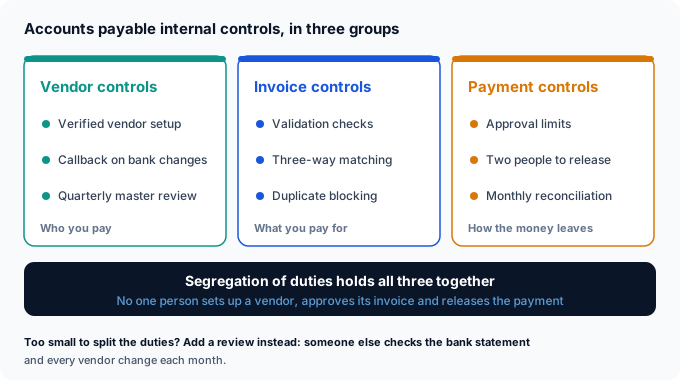
Controls run through every step of the accounts payable process, start to finish.
Accounts payable internal controls at a glance
COSO's internal control framework defines internal control as "a process, effected by an entity's board of directors, management, and other personnel, designed to provide reasonable assurance regarding the achievement of objectives relating to operations, reporting, and compliance." In AP, that means three questions: who you pay, what for, and how the money leaves [and who gets blamed when it goes wrong, ask my football team].
| Control | What it stops | Start |
|---|---|---|
| Segregation of duties | One person creating, approving and paying a fake bill | Week 1 |
| Callback on bank detail changes | Payments to a fraudster's account | Week 1 |
| Vendor master review | Fake, duplicate and dormant vendors | Month 1 |
| Invoice validation | Invoices with wrong details or for another company | Month 1 |
| Three-way matching | Paying for goods you never received | Month 1 |
| Duplicate invoice check | Paying the same invoice twice | Month 1 |
| Approval limits | Large spend nobody signed off | Month 1 |
| Monthly reconciliation and review | Errors and fraud that slipped through | Every month |
Segregation of duties in accounts payable
Segregation of duties means no single person controls a payment from start to finish. The US GAO puts it plainly: "Segregation of duties helps prevent fraud, waste, and abuse". APQC's Perry Wiggins goes further: "One person should not have the power to approve a supplier, pay invoices, and sign the checks." [I had all three powers, and a football].
Small teams often cannot split every duty. When one person has to do most of AP, add a review control on top: someone who does not process payments checks the results every month.
| If one person has to do this | Add this review |
|---|---|
| Set up vendors and process invoices | A manager reviews every new vendor and bank change each month |
| Process invoices and prepare payments | The owner or CFO releases every payment run |
| Pay invoices and reconcile the bank | Someone else reads the bank statement every month |
Vendor master data controls
Vendor master data is the list of every supplier you can pay, with their legal name, tax ID, address and bank details. If a fake vendor gets onto that list, every later control will happily process its invoices [the controls are polite, not clever].
The Washington State Auditor's Office is blunt about who should touch that list: "accounts payable clerks should not be able to add new vendors or change vendor information in the vendor master file." Three habits keep the list honest.
| Vendor control | How to run it |
|---|---|
| Verify before you add | Check the tax ID, address and a contact you found yourself, not one from the request |
| Call back on every bank change | Use a phone number you already had, never the one in the email |
| Review the list regularly | The state auditor says at least once a year; quarterly is better. Merge duplicates and block vendors you have not paid in a year |
Invoice validation
Invoice validation checks that an invoice is real, billed to you, not already paid, and adds up, before it goes any further. It is the first control most invoices meet, which makes it the cheapest place to catch a problem [like a bouncer who checks IDs before the party, not after].
Validation only works on correct data. If the invoice number is misread, the duplicate check cannot find the repeat, which is why every step of our accounts payable invoice processing guide starts with clean capture.
Controls run on data
ECIT Digital reads every invoice with AI, our team checks every field the AI is unsure about, and clean data goes into your ERP or AP tool with 99.8% accuracy guaranteed. See how invoice capture works with us.
Three-way matching
Three-way matching compares the invoice with the purchase order and the goods receipt, so you only pay for what you ordered and what actually arrived. Anything outside your tolerance becomes an exception for a person to review [the system does not care how nice the supplier is].
It is a strong control against overbilling, but it only covers invoices that have a PO. Our guide to invoice matching explains 2-way, 3-way and 4-way matching and how to set tolerances.
Invoice fraud
Invoice fraud is any attempt to get you to pay an invoice you do not owe: a fake vendor, a real vendor's invoice with changed bank details, or an inflated bill. The AFP 2026 Payments Fraud and Control Survey found 76% of US organizations experienced attempted or actual payments fraud in 2025, and 74% were hit by business email compromise.
| Type of invoice fraud | Red flag | Control that catches it |
|---|---|---|
| Fake vendor | A new vendor nobody in the business asked for | Verified vendor setup, segregation of duties |
| Changed bank details | An email asking you to pay a new account | Callback on a number already on file |
| Inflated or padded invoice | Prices or quantities above the PO | Three-way matching with tolerances |
| Invoice for work never done | No goods receipt or sign-off | Three-way matching, approval limits |
| Resubmitted invoice | Same amount, slightly different number | Duplicate invoice check |
Billing schemes are a big share of the problem. In the ACFE's Occupational Fraud 2024 report, billing fraud appeared in 22% of all cases, with a median loss of $100,000 per case, and these schemes typically ran 18 months before anyone noticed. The most common weakness behind the frauds was "a lack of internal controls (32%)" [18 months is longer than most of my gym memberships lasted].
In the UK, the classic version is the "new bank details" email. UK Finance reports £41.3m lost to invoice and mandate scams in 2025, with 68% of those losses on business accounts. The fix is the vendor master callback above: a real supplier never minds a phone call, a fake one always does.
Duplicate invoices
A duplicate invoice is the same bill entered or paid twice, usually because it arrived by email and by post, or the invoice number was keyed slightly differently. APQC benchmarks show even top performers report 0.8% of annual disbursements as duplicate or erroneous payments, against 2% for bottom performers [I once paid for the pitch twice, so I am a bottom performer].
| How a duplicate slips in | The check that catches it |
|---|---|
| Same invoice by email and by post | One front door for invoices |
| Invoice number keyed as INV-0045 once and INV45 the next time | Normalized invoice number check |
| Supplier set up twice under two names | Vendor master review |
| Statement or reminder paid as if it were an invoice | Pay only from invoices, never from statements |
The control is simple: block any invoice with the same vendor, invoice number and amount as one already in the system, and flag near-matches for a person. It works best when invoice numbers are captured exactly, dashes and leading zeros included.
Approval and payment controls
Approval controls make sure someone with budget authority signs off on the spend. Payment controls make sure the money only leaves once, to the right account, released by someone other than the person who prepared it [two keys, like a missile launch, but for the electricity bill].
| Control | How it works |
|---|---|
| Approval limits | Each approver can sign off up to a set amount; larger invoices go higher |
| Two people to release | One person prepares the payment run, another releases it in the bank |
| Bank detail check before release | Every payee's account matches the vendor master |
| Bank-side checks | Positive pay in the US, Confirmation of Payee in the UK: the bank checks the payment or the payee name before money moves |
| Monthly reconciliation | AP ledger, bank and supplier statements tied out every month |
Our invoice reconciliation guide covers the monthly tie-out in detail.
Accounts payable internal controls best practices: a starter set
You do not need every control on day one. Here is the order we would put them in for a small or mid-size team [my football team got the week 1 list, and it took a month].
Week 1: stop the expensive mistakes
Callback on every bank change, and a second person to release payments.
Month 1: clean the front door
Review the vendor list, switch on duplicate checks, and write down approval limits.
Quarter 1: match and review
Three-way matching for goods, a monthly review by someone outside AP, and reconciliation every month.
Every year: test the controls
Pick a sample of payments and check that every control actually ran.
Write the controls down in one page, with an owner for each. A control that lives only in someone's head is a habit, and habits go on holiday.
What we see in the field
We sit at the capture step for a lot of AP teams, which means we see which controls hold up and which ones are wishful thinking [no offense to wishful thinking].

- Controls are only as good as the data. A duplicate check cannot catch a repeat if the invoice number was misread the first time.
- Clients never touch the document. Our AI reads it, our team checks what the AI is unsure about, and clean data lands in their ERP or AP tool with 99.8% accuracy guaranteed.
- Approvals and payments stay with the client. We deliver the data; your team keeps the sign-off and the bank release, so your segregation of duties stays intact.
- The simple controls do the heavy lifting. A phone call on a bank change often beats a software feature.
"Construction invoices are complex and highly variable and ECIT provided a flexible and extensible data extraction model that worked wonderfully." - Terence Pua, CEO, Hinges AI
Want to see where your own controls and process stand? Run the free invoice health check: it scores your invoice process in about 3 minutes and estimates what you could save, based on your own numbers.
Controls start with clean data
Invoices in, clean data out, 99.8% accuracy guaranteed
Our AI reads every invoice, our team checks what the AI is unsure about, and validated data goes straight into your ERP or AP tool. You pay per document, with no license.
As for my football team: the new treasurer collects the money, the captain pays the pitch, and I read the bank statement once a month [I was promoted to internal audit]. The numbers have added up ever since. That is internal control in one sentence: nobody marks their own homework.
Sondre Bratlandsmo
November 19, 2026
Book free live demo
Learn how the ECIT Digital solutions can help you with the help from one of our experts.


Frequently asked questions
Accounts payable internal controls are the rules and checks that make sure a business only pays real vendors, for goods and services it actually received, the right amount, once. They include segregation of duties, vendor master data controls, invoice validation, three-way matching, duplicate invoice checks, approval limits, verified payment release and monthly reconciliation.
Segregation of duties in accounts payable means no single person controls a payment from start to finish. Different people set up vendors, approve invoices and release payments. When a team is too small to split every duty, a person outside AP reviews new vendors, bank changes and the bank statement every month instead.
Vendor master data controls protect the list of suppliers a business can pay. They include verifying a vendor's tax ID and contact details before adding it, calling back on a known phone number before changing bank details, keeping vendor changes away from the people who process invoices, and reviewing the list at least once a year to remove duplicates and inactive vendors.
Start with the controls that stop the most expensive mistakes: a callback on every bank detail change and a second person to release payments. Then review the vendor list, switch on duplicate invoice checks and write down approval limits. Add three-way matching for goods, a monthly review by someone outside AP and monthly reconciliation, and test the controls once a year.
When one person handles most of accounts payable, add review controls instead of splitting duties. The owner or CFO releases every payment run, and someone outside AP reviews new vendors, bank detail changes and the bank statement every month. These compensating controls make it much harder for an error or fraud to go unnoticed.
Internal controls stop invoice fraud at different points. Verified vendor setup and segregation of duties stop fake vendors. A callback on a known phone number stops fake bank detail changes. Three-way matching stops inflated invoices and bills for work never done, and duplicate checks stop resubmitted invoices. Monthly reconciliation catches anything that slips through.
Relevant articles
Invoice Validation: What to Check Before You Pay, and Who Checks It
Accounts Payable Invoice Processing: 8 Steps from Inbox to Payment