Invoice Reconciliation: What It Is and How to Do It
Invoice reconciliation explained: how to reconcile supplier statements step by step, a worked example with real numbers, and how to fix each common difference.
Quick answer
Invoice reconciliation is checking that the invoices and payments in your books agree with what each supplier says you owe, then explaining or fixing every difference. In accounts payable it usually means comparing your AP ledger with each supplier's statement once a month, so missing invoices, duplicates and unbooked credit notes are caught before they cost money.
Why listen to us: ECIT Digital reads supplier invoices for finance teams every day and guarantees 99.8% accuracy on the data we deliver, so we see exactly where reconciliations go wrong, usually at the very first step.
Confession: the first time I reconciled a supplier statement, I was off by $1,247.50 and spent an afternoon convinced the supplier was a criminal mastermind [squints at statement]. They were not. It was three boring little reasons, and by the end of this post you will find all three faster than I did.
This post covers the money going out, the accounts payable side. Reconciliation is step 7 in the accounts payable process, the one that proves the other six worked.
On this page
- Reconciliation vs matching, at a glance
- What is invoice reconciliation?
- How to reconcile invoices, step by step
- A worked example with real numbers
- Common differences and how to fix each
- How often to reconcile
- Invoice reconciliation at month-end
- What reconciliation catches: duplicates
- Invoice reconciliation software
- What we see in the field
Invoice reconciliation vs invoice matching vs AP reconciliation
Four checks get called "reconciliation", and every article you read seems to mean a different one [holds up four identical-looking spreadsheets]. Here they are side by side.
| Check | Compares | When | Catches |
|---|---|---|---|
| Invoice matching | Each invoice vs its purchase order and goods receipt | Before you pay | Wrong prices and quantities |
| Invoice reconciliation | Your AP ledger vs each supplier's statement | Monthly | Missing invoices, duplicates, unbooked credits |
| AP reconciliation | AP subledger total vs the general ledger control account | Month-end | Posting errors between ledgers |
| Bank reconciliation | Payments in your books vs your bank statement | Monthly or more often | Payments that never left, or left twice |
Matching happens one invoice at a time, before money moves. Reconciliation happens after, across everything with one supplier, and it is where the sneaky stuff hides [peers under the desk].
What is invoice reconciliation?
Invoice reconciliation means confirming that every invoice, credit note and payment you have recorded for a supplier matches the supplier's own records. When the balances differ, you find the reason for each difference and either correct your books or ask the supplier to correct theirs.
In plain words, it is you and your supplier comparing notes on who owes whom, politely, with numbers [shakes hands with spreadsheet]. If both sides agree, you sign it off and move on with your life.
How to reconcile invoices, step by step
To reconcile invoices, get the supplier's statement, pull your AP ledger for the same supplier and dates, match each line, list every difference, then fix or explain each one until the difference is zero.
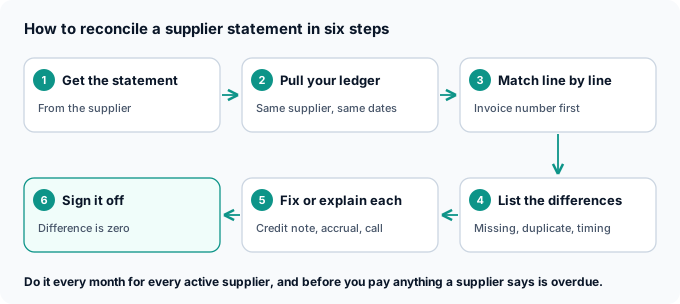
Match on invoice number first, then on amount and date, which is the order Corpay recommends too. And never pay straight from a statement: as AccountingTools warns, "it is possible that the buyer already paid for those items".
Matching on amount first is how I once paired two completely different $500 invoices and felt very clever for about four minutes [stops feeling clever].
Invoice reconciliation example, with real numbers
Here is my $1,247.50 mystery, solved. The supplier's statement said we owed $18,640, our AP ledger said $17,392.50, and three ordinary things explained the whole gap.
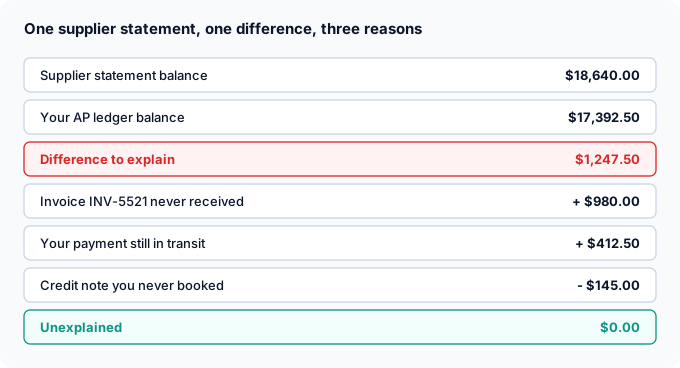
| Difference | Why it happened | What we did |
|---|---|---|
| Invoice INV-5521, $980.00 | Emailed to someone on vacation, never logged | Got a copy, matched it, booked it |
| Payment of $412.50 | We paid on 30 September, the supplier booked it on 2 October | Noted as timing, no change needed |
| Credit note, $145.00 | Supplier issued it, we never received it | Requested a copy and booked it |
No criminal mastermind, just an out-of-office reply and a slow bank [apologizes to supplier silently]. That is what most differences look like once you find them.
Common invoice reconciliation differences and how to fix each
Most reconciliation differences fall into a handful of types: missing invoices, payments in transit, duplicates, unbooked credit notes, price or quantity differences, and payments applied to the wrong invoice. Each one has a standard fix.
| Difference | Usual cause | Fix | Who acts |
|---|---|---|---|
| Missing invoice | Lost in an inbox or never sent | Ask for a copy, match it, book it | AP |
| Payment in transit | Timing between your payment and their books | Note it, check it next month | AP |
| Duplicate invoice | Same invoice sent twice or keyed twice | Void the duplicate, check it was not paid twice | AP |
| Unbooked credit note | Credit note never reached you | Request it and book it | AP and the supplier |
| Price or quantity difference | Invoice does not match the order | Ask for a corrected invoice or a credit note | AP and purchasing |
| Misapplied payment | Supplier applied it to the wrong invoice | Send remittance details and ask them to reallocate | AP and the supplier |
The worst one is the duplicate, because a duplicate that got paid is real money in someone else's bank [winces]. ACCA's examiners add transposition errors from keying invoices to the usual list, and practitioners describe statements that never quite tie and get exported to Excel every month just to find the difference, as one accounting forum user puts it.
How often should you reconcile invoices?
Most finance teams reconcile supplier statements monthly and tie the AP subledger to the general ledger at month-end. American Express suggests reconciling whenever checks are run, weekly, and at minimum at month-end. Treat that as common practice rather than a rule, and reconcile more often with your biggest suppliers.
Low-volume suppliers can wait a quarter, but never skip one just because their statements are boring [yawns at statement, regrets it later].
Invoice reconciliation at month-end
At month-end, reconciliation confirms that every liability is in the books. Reconcile your largest suppliers' statements, accrue for goods received but not yet invoiced, and tie the AP subledger to the general ledger control account before you close.
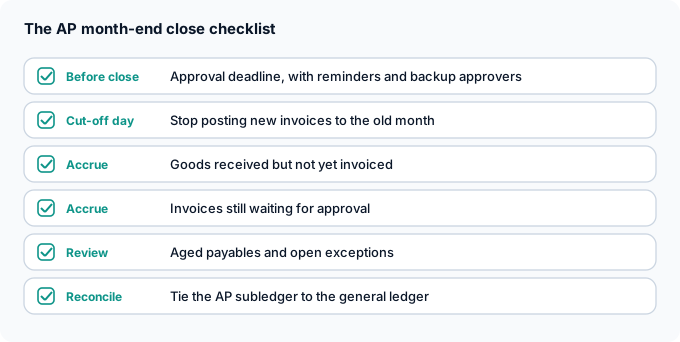
In a 2025 survey of 100 finance teams by close-software vendor Ledge, 27% needed more than seven business days to close [counts days on fingers, runs out of fingers]. Reconciling key suppliers during the month, not in the last two days, is one of the easiest ways to shorten it.
What reconciliation catches: duplicate and wrong payments
Reconciliation is your safety net for payments that slipped past matching. APQC data reported by CFO.com shows top performers lose 0.8% of annual disbursements to duplicate or erroneous payments, against 2% for bottom performers.
"Ad hoc processes are a breeding ground for errors and fraud." - Perry D. Wiggins, CFO, APQC
On a supplier you pay $1 million a year, even the good number is $8,000 [stares at the good number]. A monthly statement check is how you get some of it back.
Invoice reconciliation software: from spreadsheet to automation
Invoice reconciliation software compares supplier statements, invoices and payments automatically and flags only the differences. Most teams move from spreadsheets to the matching built into their ERP or AP tool, then automate how invoice data gets in, because reconciliation is only as good as the data it compares.
| Level | What it does | Where it runs out |
|---|---|---|
| Spreadsheet | You export the ledger and tick lines by hand | Hours per supplier, easy to miss a line |
| ERP matching | Matches invoices to POs and receipts automatically | Only as good as the invoice data keyed in |
| AP automation tool | Captures invoices and routes exceptions to your team | Your team still checks what capture got wrong |
| Capture with validation | Invoice data is read and checked before it reaches your books | Needs a provider you trust with your documents |
If the invoice in your ledger says $9,800 instead of $980, no reconciliation tool on earth will make that statement tie [sighs at the zero]. That is why we start at capture: our AP automation software reads every line and has a person check anything the AI is unsure about. For the checks before payment, see our purchase order matching use case.
What we see in the field
From where we sit, most reconciliation pain starts weeks earlier, at the moment an invoice arrives [rewinds tape].

- Missing invoices are usually inbox problems. One intake address and logging every invoice on arrival removes most of them.
- Typos create differences that look like fraud. A misread amount shows up a month later as a mystery gap.
- Credit notes need the same treatment as invoices. We read them through the same pipeline, so they get booked instead of forgotten.
- Remittance advice helps the supplier too. We also read remittance advice and match payments to invoices, which cuts misapplied payments.
Make reconciliation boring again
Clean invoice data in your ERP, 99.8% accuracy guaranteed
We read every invoice and credit note, have a person check what the AI is unsure about, and deliver validated data to your systems. You pay per document.
As for my $1,247.50: it is zero now, the supplier was never a criminal mastermind, and I sent them an apology email they did not need [hovers over send for ten minutes]. Reconcile monthly and your differences stay small enough to solve before lunch.
Sondre Bratlandsmo
October 23, 2026
Book free live demo
Learn how the ECIT Digital solutions can help you with the help from one of our experts.


Frequently asked questions
Invoice reconciliation is checking that the invoices, credit notes and payments in your books agree with what each supplier says you owe, then explaining or fixing every difference. In accounts payable it usually means comparing your AP ledger with each supplier's statement once a month.
Get the supplier's statement, pull your AP ledger for the same supplier and dates, and match each line on invoice number first, then amount and date. List every difference, fix or explain each one, and sign off when the unexplained difference is zero.
Invoice matching checks one invoice against its purchase order and goods receipt before you pay it. Invoice reconciliation happens afterwards and compares everything you recorded for a supplier with the supplier's own statement, to catch missing invoices, duplicates and unbooked credits.
Vendor statement reconciliation compares a supplier's statement of account with your accounts payable records for that supplier. It finds invoices you never received, payments the supplier has not applied, credit notes you have not booked and timing differences.
Most finance teams reconcile supplier statements monthly and tie the AP subledger to the general ledger at month-end. Reconcile your largest suppliers more often, and smaller suppliers at least quarterly. This is common practice rather than a fixed rule.
Accounts payable reconciliation checks that the total of all open supplier balances in your AP subledger matches the accounts payable balance in the general ledger. It is usually done at month-end, before the books are closed.
Relevant articles
Accounts Payable Workflow: Steps, Roles and Automation
Best AP Automation Software: 13 Tools Compared for 2026