Invoice Approval Workflow: Approval Matrix, Routing and Audit Proof
How an invoice approval workflow works: PO vs non-PO routing, a real approval matrix, holiday cover, what counts as a valid approval, and the audit evidence.
Quick answer
An invoice approval workflow is the set of rules that decides who must sign off on a supplier invoice before it is paid, based on the amount, the department and whether a purchase order exists. PO invoices are usually approved by matching them to the purchase order and goods receipt, so only mismatches reach a person. Non-PO invoices go to the budget owner, and up to the next level when they exceed that person's approval limit.
Why listen to us: ECIT Digital reads supplier invoices for finance teams every day and delivers the checked data into the ERP or AP tool where their approvals run.
An invoice approval is a permission slip for money. The invoice wants to go on a school trip to the bank, and someone with authority has to sign the form [I once signed my own in crayon; the teacher was not fooled, and neither is your auditor].
This guide covers who should sign, up to what amount, what happens when they are on a beach, and what proves the signature is real. It is part of our guide to the accounts payable process [the slip is step 5, wedged between matching and paying].
| PO invoice | Non-PO invoice | |
|---|---|---|
| Who says yes to the spend | Whoever approved the purchase order, before anything was ordered | The budget owner, after the invoice arrives |
| What AP checks | Invoice against PO and goods receipt, within tolerance | Coding, amount and the approver's limit |
| When a person gets involved | Only when the match fails | Every time |
| Typical examples | Stock, materials, equipment | Utilities, subscriptions, legal fees, one-off services |
Common practice in US AP teams. Your own rules may differ.
What is an invoice approval workflow?
Approval is the moment someone with authority says yes, this spend is real and expected. The GAO's internal control standard puts it plainly: transactions should be "authorized and executed only by persons acting within the scope of their authority" [scope of authority is government for "not the intern"].
Approval is not the same as matching, though people mix them up all the time. Matching checks that the numbers agree; approval checks that someone allowed to spend the money actually wanted to [a slip can be filled in perfectly and still need a parent's signature]. Our guide to invoice matching covers the number side.
How it runs: PO vs non-PO invoices
Every invoice takes one of two roads, and the road depends on whether a purchase order came first [spoiler: the PO road is shorter and has snacks].
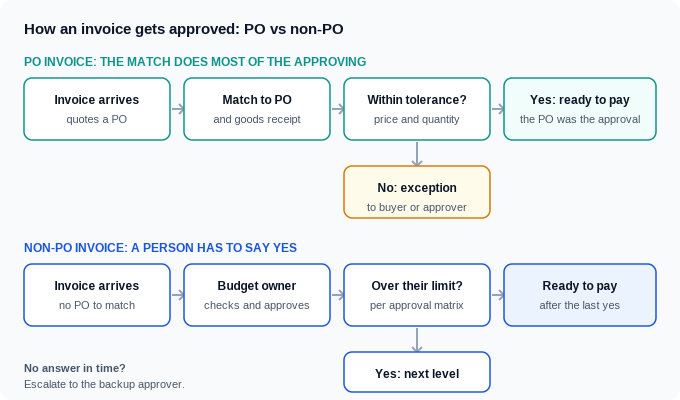
On a PO invoice, the real approval happened when the purchase order was raised. Many teams let a PO invoice go to payment without another signature if it matches the PO and goods receipt within tolerance, and send only the mismatches to a person (common practice, not a rule) [asking a parent to sign the same slip twice just annoys the parent]. Our guide to three-way matching explains how tolerances work.
On a non-PO invoice, nobody has said yes yet. It goes to the budget owner, who confirms it is real, checks the coding and approves it [our guide to invoice coding has the coding part]. Anything above their limit climbs to the next level, like a slip going from mum to grandma, who has opinions.
Who approves what: the approval matrix
An approval matrix, also called a delegation of authority, lists who can approve how much. Without one, every invoice gets approved by whoever replies to email fastest [usually me, and nobody should trust me with your toner budget].
Here is a real one. Adelphi University publishes its signature limits for purchase orders and vendor payments:
| Level | Who | Can approve up to |
|---|---|---|
| Level 4 | Staff given authority by levels 1 to 3 | $5,000 |
| Level 3 | Department heads and directors | $25,000 |
| Level 2 | Chief officers, associate provosts, assistant VPs, deans | $100,000 |
| Level 1 | Senior Leadership Council | $250,000 |
Source: Adelphi University, Authorized Signature Policy, reviewed March 2025.
To set your own tiers, start from your invoice amounts, not your org chart. If most invoices are under $5,000 each, one approver can handle that band and senior people can save themselves for the big ones (practitioner advice; there is no official right number) [your CFO does not want to approve the coffee pods, I asked].
How many levels? The GAO says management "may require approval from multiple levels" for transactions that carry more risk. One to three levels is common practice for mid-size businesses, because every extra level is another fridge door for the slip to get lost behind.
Add three rules to the matrix. Stanford's finance rules say "The transaction preparer cannot also approve the transaction" and the approver cannot benefit from it [no signing your own permission slip, as established]. The third: watch for invoices split to stay under a limit, like two $4,990 bills from one supplier on the same day.
When the approver is away
The most common approval problem is not fraud. It is a beach [the approver is on it, the invoice is not].
| Rule | What to write down |
|---|---|
| A backup for every approver | Same department, same or higher limit, named in the matrix |
| A reminder, then an escalation | The number of days, set from your payment terms so late approvals never become late payments |
| The delegate's limit | Their own limit or the absent approver's: pick one |
| A delegated approval log | Who approved, and on whose behalf |
Common practice in AP teams, not a regulation.
Decide the delegate's limit before anyone needs it [deciding mid-crisis is how you get an argument by the printer]. These rules stop the classic scene where an invoice spends three weeks in an inbox and the supplier starts calling you by your first name [hi, Dave].
What counts as a valid approval
A valid approval answers four questions: who approved, what exactly, when, and with what authority. A thumbs-up emoji answers none of them [I have tried; the auditor did not laugh].
| Approval method | Proves who? | Tied to the invoice? | Audit-ready? |
|---|---|---|---|
| Approval inside your AP tool or ERP, with a login | Yes | Yes | Yes |
| Electronic signature on the invoice | Yes, if the tool verifies identity | Yes | Usually |
| Reply to an email | Weak: emails can be spoofed or forwarded | Only if the invoice is attached | Weak |
| Chat message or a verbal yes | No | No | No |
Practitioner summary. Ask your auditor what they accept.
Digital approvals are legally sound. The US ESIGN Act says a signature or record "may not be denied legal effect, validity, or enforceability solely because it is in electronic form" [the crayon was never the problem; it was whose hand held it].
Email is the risky one. The FBI's 2025 Internet Crime Report counted $3,046,598,558 in business email compromise losses from 24,768 complaints [that is three billion dollars of "quick favor, can you pay this today?"]. Anyone who can fake a supplier's email can fake a manager's "approved" reply too.
Approvals and audit evidence
Auditors do not just want to hear that you approve invoices; they want to see it. For US public companies, SEC rules define internal control over financial reporting to include reasonable assurance that spending is made "only in accordance with authorizations of management and directors" [that is the permission slip, wearing a suit].
Splitting the jobs matters as much as the signature. The GAO wants duties separated "so that no one individual controls all key aspects of a transaction", so the person who adds a supplier should not approve its invoices or release the payment [one person doing all three is not efficient, it is a plot]. Our guide to accounts payable internal controls covers the full set.
| Job | Usually done by | Should not also |
|---|---|---|
| Add or change a supplier | Vendor master owner | Approve that supplier's invoices |
| Approve the invoice | Budget owner | Release the payment |
| Release the payment | Treasury or AP lead | Edit supplier bank details |
Common practice. Small teams that cannot split every job add a review step instead.
Then keep the proof with the invoice. The IRS says the record rules for paper "apply as well to machine-sensible books and records", so a digital approval log needs the same care as a filing cabinet [a shoebox of slips technically counts; please do not].
Digital invoice approval and automation
Digital invoice approval means the invoice, its data and the approval live in one system, instead of a printout traveling from desk to desk [mine once traveled to a desk that turned out to be a bin].
| Manual approval | Digital approval | |
|---|---|---|
| Routing | Someone forwards an email | Rules route by amount, department and supplier |
| Reminders | AP chases by phone | Automatic reminders and escalation |
| Holidays | The invoice waits | The backup approver takes over |
| Evidence | An email thread, somewhere | A log of who approved what, and when |
Invoice approval automation goes one step further. The GAO describes automated approvals that "authorize transactions without human intervention" for lower-risk items, such as a PO invoice that matches perfectly [the slip that signs itself, but only for the trip to the library].
Speed is the prize. Ardent Partners puts the average invoice processing time at 8.2 days, and says best-in-class teams are 79% faster [I would like to be 79% faster at anything]. That figure covers the whole process, not approval alone. Our guide to touchless invoice processing covers the rest.
Approvers approve what they see
Here is the part nobody mentions: an approver signs off on whatever the screen shows them. If the amount was keyed in wrong or the invoice was matched to the wrong supplier, the approval is perfectly valid and perfectly wrong [a parent who signs for the zoo trip has not agreed to the bungee jump on the back].

We do not run approvals. ECIT Digital sits before them, so the slip your approvers sign says what the invoice really says:
- Every line, not just the total. Our AI reads the supplier, PO number, line items and tax from every invoice, whether it arrives as PDF or paper.
- Checked by people. Our team reviews what the AI is unsure about, with 99.8% accuracy guaranteed.
- Into your system. We deliver the data into your ERP or AP tool by API, where your approval workflow runs.
See how it works on our invoice processing services and PDF to electronic invoice pages.
Want to see how ready your invoice process is today? Run the free invoice health check: it scores your invoice process in about 3 minutes and estimates what you could save, based on your own numbers.
Clean data, then approval
Every invoice read and checked before anyone approves it
AI capture plus human validation, with 99.8% accuracy guaranteed. You pay per document, with no license.
So: write down who signs, up to what amount, and who signs when they are away, then keep the proof. Every invoice gets its permission slip, and nobody signs in crayon [I have retired the crayon. Mostly].
Sondre Bratlandsmo
November 24, 2026
Book free live demo
Learn how the ECIT Digital solutions can help you with the help from one of our experts.


Frequently asked questions
An invoice approval workflow is the set of rules that decides who must sign off on a supplier invoice before it is paid. The rules usually depend on the invoice amount, the department or cost center, and whether the invoice is backed by a purchase order.
The budget owner for the spend should approve it, within the limit set in the company's approval matrix. Invoices above that limit go to the next level. The person who requested or prepared the purchase should not be the only approver, and nobody should approve a payment that benefits them.
There is no official number. One to three levels is common practice for mid-size businesses, with extra levels only for larger or riskier amounts. Each extra level adds another place for an invoice to wait, so set the tiers from your actual invoice amounts.
Often not. The spend was approved when the purchase order was raised, so many teams pay a PO invoice without another signature if it matches the purchase order and goods receipt within tolerance. Invoices that do not match go to a person to resolve. Check what your own policy and auditor require.
It is a weak one. Electronic approvals are legally valid in the US under the ESIGN Act, but an email reply is hard to tie to a specific invoice and can be spoofed or forwarded. An approval recorded inside the AP tool or ERP, under the approver's own login, is stronger evidence for an audit.
Invoice matching checks that the invoice agrees with the purchase order and goods receipt. Invoice approval confirms that someone with authority to spend the money agrees the cost is real and expected. A PO invoice that matches has usually been approved already through the purchase order; a non-PO invoice always needs an approver.
Relevant articles
Invoice Fraud: 6 Types, Red Flags and How to Detect It
Invoice Coding: What GL Coding Is, Who Does It, and How to Fix Mistakes