Legal Document Data Extraction: What to Pull From Contracts and How
Legal document data extraction explained: the fields to pull from contracts, why renewal dates matter most, how it works, where AI goes wrong, and where legal review starts.
Quick answer
Legal document data extraction is pulling key facts out of contracts and other legal documents, such as the parties, effective date, term, renewal and notice periods, fees, payment terms and governing law, and turning them into structured data for a contract register or other system. It is done with AI that reads the text, validation rules, and a person who checks fields the AI is unsure about. It captures what a document says; deciding what a clause means or whether it is risky stays with your lawyers.
Why listen to us: ECIT Digital turns business documents, including contracts, into checked data for companies every day and delivers it into the systems they already use.
I am still paying for a meditation app I opened once. It renewed itself three times because I never found the cancel date [I am very calm about it; the app worked].
Companies do the same thing with contracts, only the meditation app is a $100,000 software deal. This guide covers what to extract from legal documents, why the dates matter most, how extraction works, where AI gets it wrong, and where extraction stops and your lawyers start. It is part of our guide to document process automation [the calm, well-organized version of me].
| Document | Fields usually extracted | Why it matters |
|---|---|---|
| Service or supply agreement | Parties, effective date, term, renewal, notice period, fees, payment terms | Renewals, budgets and supplier payments |
| NDA | Parties, effective date, duration of confidentiality, governing law | Knowing what you may share, and for how long |
| Lease | Landlord, tenant, premises, start and end dates, rent, escalations, break options | Rent payments and key dates |
| Statement of work | Linked agreement, deliverables, milestones, fees | Matching invoices to agreed work |
| Amendment | Which agreement it changes, what changes, effective date | Keeping the register up to date |
Common field lists. Your own register decides which fields you need.
What is legal document data extraction?
Legal document data extraction turns contracts, NDAs, leases and similar documents into structured data. Instead of a 30-page PDF in a shared drive, you get a row with the parties, the dates and the money [the PDF is still there; it just stops being the only place the facts live].
You will also hear it called contract data extraction or contract extraction. It is the same job: find the facts, label them and put them where people can search, sort and set reminders [a very boring superpower, and the best kind].
The key word is data. Extraction tells you the notice period is 90 days. It does not tell you whether 90 days is a good idea, which is a question for your lawyers [and, apparently, for my meditation app].
Contract data extraction: the fields that matter
Most contracts carry the same handful of facts, written in very different ways. Here they are on a made-up agreement [no real companies were harmed in the making of this contract].
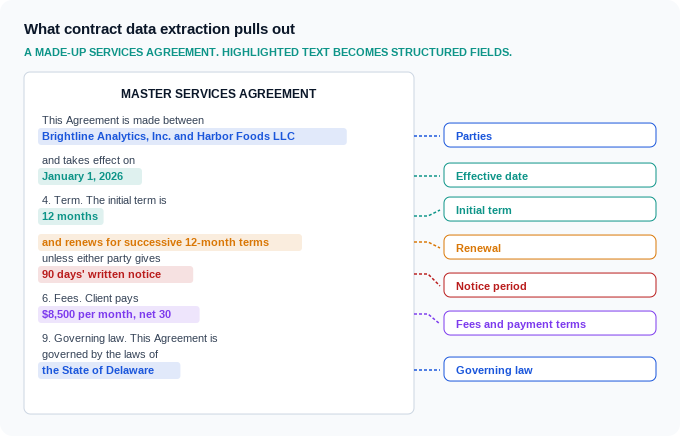
The facts are rarely in one place. The parties are on page one, the term is in section 4, the fees are in a schedule at the back, and the notice period hides in a sentence that starts "unless" [lawyers love the word "unless" the way I love snacks].
Defined terms make it harder. A contract that says "the Services" on page 12 means whatever it defined on page 2, so good extraction keeps the definition with the field [otherwise "the Services" could mean anything, including my meditation app].
Why the dates matter most
Of all the fields, dates cause the most expensive surprises. A missed notice deadline does not send a reminder; it just renews [quietly, politely, for another year].

Three extracted fields, effective date, term and notice period, give you one deadline that matters: October 2. Put that date in a calendar with an owner, and you decide whether to renew instead of the contract deciding for you [I wish someone had done this for my app].
Getting contracts wrong is not cheap. World Commerce & Contracting says "the average business loses almost 9% of value annually through poor contract management", with the worst performers at 15% or more. Not all of that is missed renewals, but knowing your own dates is the cheapest place to start.
How legal document data extraction works
The process is the same as for any document, with more pages and more patience. Five steps [six if you count the coffee].
| Step | What happens | What to watch |
|---|---|---|
| 1. Collect | Gather contracts from shared drives, email and filing cabinets | Find the signed version, not the last draft |
| 2. Classify | Sort them by type: agreement, NDA, lease, amendment | Link amendments to the agreement they change |
| 3. Extract | AI finds the fields you asked for, with the page each one came from | Keep the page reference so anyone can check the source |
| 4. Validate | Rules check the data, and a person checks fields the AI is unsure about | End date after start date, notice period shorter than the term |
| 5. Deliver | Clean data goes into your contract register or other system | Owners and reminders for every key date |
Step 1 is where most projects find their first surprise: three versions of the same contract, and nobody sure which one was signed [the one with the coffee stain is usually the real one]. Scanned paper contracts work too, they just need to be scanned clearly first.
Where AI gets legal documents wrong
AI reads legal language far better than it used to. It still makes mistakes, and in legal documents a confident mistake is worse than a blank [a blank at least admits it does not know].
Even specialist legal AI tools get things wrong. When Stanford researchers tested leading AI legal research tools, they found that two of them "produced incorrect information more than 17% of the time", and a third more than 34% of the time. That study was about legal research, not extraction, but the lesson carries over: check the output.
| Where it goes wrong | What it looks like | What to do |
|---|---|---|
| Amendments | The original says 12 months; an amendment changed it to 24 | Link amendments and take the latest value |
| Relative dates | "Two years after the Effective Date" | Extract the rule and calculate the date |
| Defined terms | "Fees" defined in a schedule, used everywhere else | Read the definition with the field |
| Poor scans | A faded, signed copy from 2014 | Send unreadable pages to a person |
| Missing fields | No renewal clause at all | Record "not stated", never guess |
The fix is the same as for invoices: AI for the volume, rules for the impossible values, and a person for the fields the AI is unsure about. Our guide to invoice data extraction explains that setup in more detail [same idea, fewer Latin words].
Extraction is not legal review
This is the line every legal team should draw clearly. Extraction captures what the document says; legal review decides what it means and whether it is acceptable [one is reading, the other is judging, and only one of them went to law school].
| Data extraction does | Your lawyers do |
|---|---|
| Captures the notice period: 90 days | Decide whether to give notice |
| Captures the liability cap amount | Decide whether the cap is acceptable |
| Captures the governing law: Delaware | Advise on what that means for a dispute |
| Flags that a renewal clause exists | Negotiate better terms next time |
Keeping that line clear makes both jobs better. Your lawyers stop retyping dates into spreadsheets, and spend their time on the judgment calls only they can make [and I stop pretending to be one, which everyone agrees is for the best].
Contract data, read and checked
We do the reading part. ECIT Digital pulls the data out of your contracts and legal documents and checks it; we do not review clauses or give legal advice [I did try once, and it is how I ended up with the meditation app].

- Any document type. Our AI reads contracts, NDAs, leases and other legal documents, and pulls out the fields you ask for, from PDF, email or paper. Paper is scanned by our partners.
- Checked by people. Our team checks every field the AI is unsure about before the data is delivered.
- Into your system. We deliver the data by API into your contract register or other system, and our team handles the setup.
- Pay per document. No expensive license.
See how it works on our contract and legal document review use case and our document process outsourcing page.
Know your dates
Your contracts in, the facts out, checked by people
AI extraction plus human validation, delivered into your system. You pay per document, with no license.
So: decide which fields you need, link every amendment, keep the page reference, and put every notice deadline in a calendar with an owner. Leave the judgment to your lawyers [and if anyone knows how to cancel a meditation app, my inbox is open].
Sondre Bratlandsmo
November 25, 2026
Book free live demo
Learn how the ECIT Digital solutions can help you with the help from one of our experts.


Frequently asked questions
Legal document data extraction is pulling key facts out of contracts and other legal documents, such as the parties, effective date, term, renewal and notice periods, fees, payment terms and governing law, and turning them into structured data for a contract register or other system.
Most teams start with the parties, effective date, initial term, renewal terms, notice period, fees and payment terms, and governing law. Many also capture the liability cap, termination rights and the page each field came from, so anyone can check the source.
No. Contract data extraction captures what a document says, such as a 90-day notice period. Contract review decides what a clause means, whether it is acceptable and what to negotiate, which is work for lawyers.
AI handles most fields well, but it can miss amendments, misread relative dates or defined terms, and state wrong values confidently. Reliable setups combine AI with validation rules and a person who checks the fields the AI is unsure about.
Extract the effective date, term, renewal terms and notice period from each contract, calculate the last day to give notice, and put that date in a calendar or contract register with a named owner and a reminder well before it.
An amendment can change the term, fees or other fields in the original agreement. Each amendment should be linked to the agreement it changes, and the register should show the latest value, with the amendment as its source.
Relevant articles
IDP vs OCR: The Difference and Which One You Need
Duplicate Invoices: How They Slip In and How to Detect Them