Purchase Order vs Invoice: Differences and How They Match
Purchase order vs invoice: who sends each one, what goes on them, why the PO number matters, and what to do when the two do not match.
Quick answer
A purchase order is the buyer's document that says what it wants to buy, how many and at what price, before anything ships. An invoice is the seller's document that asks to be paid for what was delivered. The purchase order comes first and approves the spend. The invoice comes last and gets paid once it matches the purchase order.
Why listen to us: ECIT Digital reads both of these documents for a living. Our platform turns customers' purchase orders into data for order systems and supplier invoices into data for ERPs, and we guarantee 99.8% accuracy on the invoice data.
Confession: for an embarrassingly long time I thought a purchase order and an invoice were the same piece of paper wearing different hats [hangs head]. They are not. One says "please send me this", the other says "please pay me for that", and mixing them up is how companies pay for chairs nobody received.
Speaking of chairs, throughout this post we will follow PO-1187, an order for 40 office chairs at $150 each. It looks innocent. It is not, and something goes wrong with it around section five [apologizes in advance to everyone who has to sit down].
Purchase order vs invoice: the key differences
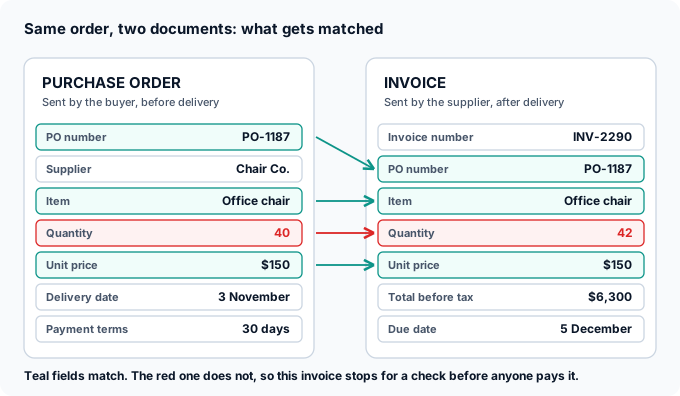
A purchase order and an invoice describe the same deal from opposite ends. Here is the whole comparison on one screen, for people who skipped straight to the table (hi, I see you, I do it too).
| Purchase order | Invoice | |
|---|---|---|
| Who creates it | The buyer | The seller |
| When | Before the goods or services are delivered | After delivery, or when the goods ship |
| What it does | Approves and describes the purchase | Asks to be paid |
| Key number | PO number | Invoice number, plus the buyer's PO number |
| Typical contents | Items, quantities, agreed prices, delivery date, payment terms | Items delivered, quantities, prices, tax, total due, due date |
| What it triggers | The seller ships or starts work | The buyer pays, once the invoice matches |
| Legal role in the US | An offer to buy, binding once the seller accepts | A request for payment, and a tax record where VAT applies |
What is a purchase order?
A purchase order (PO) is a document the buyer sends to a supplier to order goods or services. It lists what is being bought, how many, the agreed price, the delivery date and the payment terms, and it carries a unique PO number.
Think of it as the company's permission slip [signs it with a flourish]. Under the US Uniform Commercial Code, an order to buy goods is treated as an offer that invites acceptance, and the seller can accept by promising to ship or simply by shipping.
So yes, once the supplier accepts, PO-1187 is a binding deal for 40 chairs. This is general information, not legal advice, so check your own terms with someone who bills by the hour [nervously checks own terms].
What is an invoice?
An invoice is the document the seller sends to ask for payment. It lists what was delivered, quantities, prices, tax, the total due and the due date, and it carries a unique invoice number. A good invoice also repeats the buyer's PO number, so the buyer can match it to the original order.
In the UK, a full VAT invoice has a fixed list of required details, including a unique number, the supplier's VAT number, the tax point and VAT per line. The US has no single federal checklist, which is either refreshing freedom or a recipe for chaos, depending on how many supplier invoices you open before lunch.
Which comes first, the purchase order or the invoice?
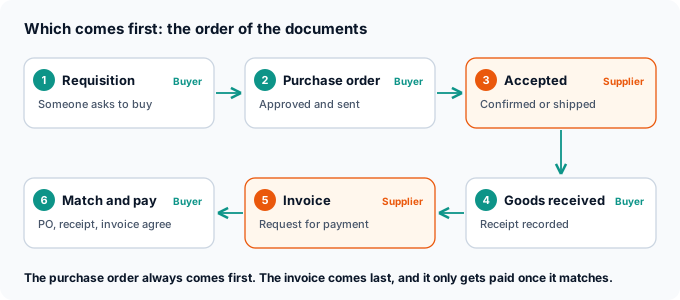
The purchase order always comes first. The buyer raises and approves it, the supplier accepts it and delivers, the buyer records the goods receipt, and only then does the supplier send the invoice. The invoice is paid last, after it has been matched against the PO and the receipt.
If an invoice ever shows up before the purchase order exists, that is not efficiency. That is a time traveler, and time travelers should be asked for a PO number like everyone else [narrows eyes].
What is a PO number on an invoice?
The PO number on an invoice is the buyer's purchase order number, copied onto the invoice by the supplier. It tells the buyer's accounts payable team which order the invoice belongs to, so they can match it and pay it. It usually sits in the invoice header, next to the invoice number and date.
A PO number is not the same as an invoice number. The buyer creates the PO number, the seller creates the invoice number, and the two meet on the invoice like a blind date that went surprisingly well [plays soft music]. On our running example, invoice INV-2290 carries PO-1187.
Forget the PO number and the invoice usually comes straight back. The University of Plymouth is blunt about it: "Any invoices without an official PO number will be returned to you and may delay payment". Most companies with a "no PO, no pay" rule work the same way, so suppliers, please, I am begging you, copy the number.
What happens when the purchase order and invoice do not match?
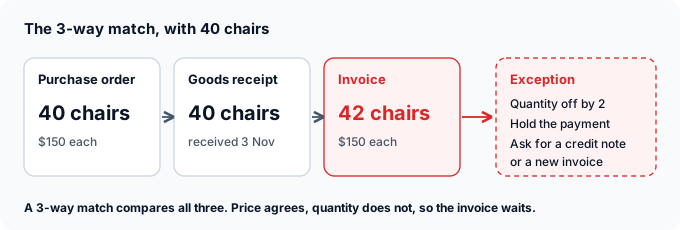
When an invoice does not match its purchase order, it becomes an exception and payment is held until someone resolves it. Accounts payable compares the invoice to the PO (a 2-way match) or to the PO and the goods receipt (a 3-way match), within a tolerance the company sets.
And here we go. PO-1187 ordered 40 chairs, the warehouse received 40 chairs, and the invoice arrived for 42 chairs [drops coffee]. Price matches, quantity does not, so the invoice stops until the supplier sends a credit note or a corrected invoice.
This is not a rare event, no matter how special PO-1187 made you feel. Ardent Partners' 2026 benchmark puts the average invoice exception rate at 19.9%, and in an earlier Ardent study, 68% of respondents named a discrepancy between the PO and the invoice as a top cause of exceptions. Microsoft's own documentation uses a nearly identical worked example with batteries and a 5% price tolerance.
The usual suspects are a price that changed after the PO, a partial delivery, the wrong PO number, or a PO closed too early. Ohio University warns that once a PO is closed before the invoice arrives, it cannot be reopened to finish invoicing, which is the accounting version of locking the door before your guest arrives. Our purchase order matching use case shows how this gets checked automatically.
Can you invoice without a purchase order?
Yes. Many invoices never had a purchase order, such as utilities, subscriptions, rent and one-off services. These non-PO invoices skip the match and go to an approver instead, which makes them slower and riskier to process.
| PO-backed invoice | Non-PO invoice | |
|---|---|---|
| How it is checked | Matched against the PO, and often the goods receipt | No order to match against |
| Who approves it | Usually nobody, if it matches | A budget owner, every time |
| Typical examples | Stock, parts, equipment, contracted services | Utilities, rent, subscriptions, one-off services |
| Main risk | Price or quantity mismatches | Paying for something nobody agreed to |
Most invoices do have one. Ardent Partners research has found that over 60% of invoices are linked to a purchase order, and best-in-class teams in Ardent's 2019 study had POs for 79% of their invoices, with a 2.5 times higher rate of straight-through processing. As one AP software company puts it, "a non-PO invoice is born as an exception" [nods gravely].
"Ardent Partner's advice is to follow the lead of best-in-class organizations when it comes to POs and that is: No PO, No Pay." - Bill McCouch, SVP Procurement Services, Corcentric
For the full journey from inbox to payment, see our guide to the accounts payable process. Fair warning, it also has a running joke, and this one is about printer toner.
Purchase order vs sales order vs invoice vs receipt
Four documents get mixed up constantly, mostly because they all have numbers on them and look official [squints at all four]. Here is who sends each one, and what it means.
| Document | Sent by | What it means |
|---|---|---|
| Quote | Seller | "Here is what it would cost" |
| Purchase order | Buyer | "Yes, I want to buy this, at this price" |
| Sales order | Seller | "Confirmed, we will deliver it" |
| Invoice | Seller | "Delivered, please pay" |
| Receipt | Seller | "Paid, thank you" |
A blanket purchase order is one long-running PO that covers many deliveries over a period, like a year of office supplies. Each invoice is matched against what is left on it, which is efficient right up until someone forgets the blanket is nearly used up.
Invoice and purchase order software: matching them automatically
Invoice and purchase order software reads both documents, pulls out the PO number, items, quantities and prices, and matches them line by line. Clean matches flow straight to approval, and only the mismatches land on a person's desk.
The hard part is not the matching. It is getting the data off a PDF in the first place, because suppliers send invoices in more layouts than there are chairs in PO-1187 [counts chairs again, gets 42]. That is where invoice scanning software, with a person checking anything the AI is unsure about, makes the match reliable. If customers send you their purchase orders as PDFs too, our PDF to electronic order service turns them into order data for your system.
What we see in the field
From where we sit, purchase orders and invoices arrive the same way: as PDFs, scans and the occasional e-invoice, all in one inbox, all with slightly different ideas about where the PO number goes [sighs in data extraction].

- We read the PO number wherever the supplier put it. Header, footer or buried in a line description, it gets pulled out so the match can happen.
- Line items matter more than totals. A total can match while two lines quietly disagree, so we capture every line, not just the bottom number.
- People check what the AI doubts. When our model is not confident about a field, someone on our team verifies it before the data leaves. That is what the 99.8% accuracy guarantee rests on.
- Paper still exists. Paper documents are scanned by our partners first, then processed like any other file.
Stop matching by hand
Clean PO and invoice data in your ERP, 99.8% accuracy guaranteed on invoices
We read every invoice, header and line items, check what the AI is unsure about, and deliver validated data ready for matching. You pay per document.
As for PO-1187: the 42 turned out to be a typo, the supplier sent a credit note for two chairs that never existed, and the invoice got paid exactly once. I still check the hallway for the missing two [peers around corner]. They were never there, and somehow that is worse.
Sondre Bratlandsmo
October 22, 2026
Book free live demo
Learn how the ECIT Digital solutions can help you with the help from one of our experts.


Frequently asked questions
No. A purchase order is sent by the buyer before delivery to order goods or services at an agreed price. An invoice is sent by the seller after delivery to ask for payment. The invoice should quote the PO number so the two can be matched.
It is the buyer's purchase order number, copied onto the invoice by the supplier. It tells the buyer's accounts payable team which order the invoice belongs to, so it can be matched and paid. It usually sits in the invoice header, near the invoice number and date.
No. The buyer creates the PO number when it places the order, and the seller creates the invoice number when it bills. A good invoice shows both numbers.
Yes. The buyer issues the purchase order first, the supplier delivers, and then the supplier sends the invoice. The invoice is paid once it matches the purchase order and, in a 3-way match, the goods receipt.
Yes. Utilities, rent, subscriptions and many one-off services are invoiced without a purchase order. These non-PO invoices are approved by a budget owner instead of being matched. Companies with a no PO, no pay policy will return invoices that should have carried a PO number.
In the US, a purchase order for goods is generally treated as an offer to buy, and it becomes a binding contract once the seller accepts it, for example by confirming the order or shipping the goods. The exact terms depend on the purchase order and any contract, so check with a lawyer for your situation.
A 3-way match compares the supplier invoice with the purchase order and the goods receipt before the invoice is paid. If prices and quantities agree within your tolerance, the invoice moves on to approval. If they do not, it becomes an exception for purchasing or the supplier to resolve.
Relevant articles
Accounts Payable Process: 7 Steps, Flow and Best Practices

Best Kofax Alternatives for Invoice Processing and Document Capture (2026)
