E-Invoicing in Europe: Country Mandates and What They Mean for UK Businesses
Which EU countries require e-invoicing and when, whether UK businesses selling to the EU are covered, Peppol vs government platforms, and what to do now.
Quick answer
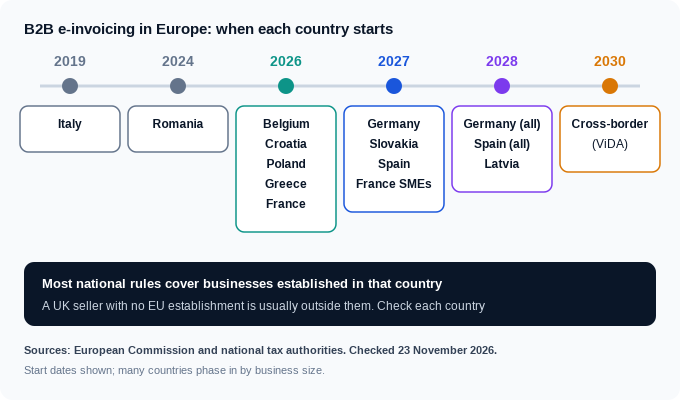
E-invoicing in Europe is being made mandatory country by country. Italy has required B2B e-invoices since 2019, Belgium, Croatia and Poland since 2026, France since September 2026, and Germany, Slovakia and Spain follow in 2027 and 2028. Since 14 April 2025, EU rules let every member state do the same, and from 1 July 2030 e-invoicing becomes the default for cross-border B2B trade inside the EU. Most national rules apply to businesses established in that country, so a UK seller with no EU establishment is usually outside them.
Why listen to us: ECIT Digital runs a certified Peppol access point, the network several of these countries use. UK businesses can send and receive e-invoices through us today.
European e-invoicing is like European plug sockets: every country picked its own, and we always pack the wrong adapter [we once took a UK plug to Belgium, we are not proud of it].
The good news for UK businesses is that most of these rules are not about you. The less good news is that your EU customers and suppliers are now living by them, so you will feel the effects anyway. This guide covers which countries require what, whether any of it applies to a UK seller, and what to do [no adapter required, probably].
For the UK's own rules, see our complete guide to UK e-invoicing.
Is e-invoicing mandatory in Europe?
In a growing list of countries, yes. The EU's VAT in the Digital Age package (ViDA) opened the door: the European Commission's ViDA implementation strategy says that from 14 April 2025, "Member States are able to introduce mandatory e-invoicing under specific conditions" [and they did, with enthusiasm].
Two more dates sit on the horizon. From 1 July 2030, the Commission says digital reporting "will affect cross-border B2B transactions", where "e-invoicing will become mandatory and the default method for invoicing". By 1 January 2035, countries with their own real-time reporting systems must align them with the EU one [2035, so there is still time to buy the right adapter].
E-invoicing mandates by country
Here is every country we could confirm on an official government site. If a country is missing, it is because we could not verify it, not because it has nothing planned [we would rather be short than wrong, a rare quality in a blog post].
| Country | B2B e-invoicing required from | How invoices travel | Source |
|---|---|---|---|
| Italy | 1 January 2019 | SdI, the government platform | MEF |
| Romania | 2024 (sent through RO e-Factura from 1 July 2024) | RO e-Factura, the government platform | ANAF |
| Belgium | 1 January 2026 | Peppol | FPS Finance |
| Croatia | 1 January 2026 (some businesses only receive until 2027) | Access points plus tax authority reporting | Tax Administration |
| Poland | 1 February 2026 for the largest businesses, 1 April 2026 for the rest | KSeF, the government platform | KSeF |
| Greece | 2 March 2026 for larger businesses, phase-in for the rest from 2 November 2026 | myDATA, the government platform | AADE |
| France | 1 September 2026: all must receive, large and mid-size must issue. 1 September 2027: smaller businesses issue | Approved platforms | impots.gouv.fr |
| Germany | Issuing: 1 January 2027 above EUR 800,000 turnover, 1 January 2028 for everyone | No set network | UStG section 27 |
| Slovakia | 1 January 2027 | Peppol | Financial Administration |
| Spain | 6 October 2027 above EUR 8 million turnover, 6 October 2028 for the rest | Private solutions plus a public one | Agencia Tributaria |
| Latvia | 1 January 2028 | Not confirmed | Ministry of Finance |
Dates in this table were checked on 23 November 2026. They move [Greece has already moved its start date once this year, we are keeping a close eye on Greece], so check the source before you plan around one.
Do UK businesses have to send e-invoices to EU customers?
Usually not, if you have no business establishment in that country. Most of these mandates are written for local businesses trading with each other [the plug socket is for the locals, you are just visiting].
| Country | What the official rule says about non-local businesses |
|---|---|
| Belgium | VAT-registered businesses "not established in Belgium without a permanent establishment" are "not subject to the obligation" (the law is still being amended on this point) |
| France | E-invoicing covers trades "réalisées entre assujettis à la TVA établis en France" (between VAT-registered businesses established in France). Some foreign businesses may still have to report sales |
| Germany | An e-invoice is required when both the supplier and the customer are based in Germany |
| Poland | Businesses with no seat or fixed establishment in Poland are excluded, though they may use KSeF voluntarily |
| Croatia and Slovakia | Apply to domestic taxpayers |
Sources: Belgium, France, Germany, Poland.
Two big exceptions. If you have a branch or other permanent establishment in one of these countries, the local rules can apply to you [surprise, you are a local now]. And Romania is different: there, foreign companies registered for Romanian VAT had to report their B2B invoices through RO e-Factura from 2024.
Even where the law does not cover you, your customers might still ask for an e-invoice. Once a Belgian buyer's whole system runs on Peppol, a PDF from you becomes the awkward one in the pile [nobody wants to be the UK plug in a Belgian socket].
Receiving invoices from EU suppliers
The rules on your suppliers mostly cover invoices to customers in their own country. Germany's rule, for instance, needs both sides to be based in Germany, so an invoice from a German supplier to you in the UK falls outside it [you may keep getting PDFs, sorry].
| Invoice from | To | What to expect |
|---|---|---|
| German supplier | German customer | E-invoice required from 2027 or 2028 |
| German supplier | You, in the UK | Outside the German rule: PDF or e-invoice, as agreed |
| Belgian supplier on Peppol | You, on Peppol | Can arrive as data, straight into your system |
| Supplier not on Peppol | You | Still a PDF or paper |
That said, some EU suppliers will move their whole invoicing onto Peppol or a national platform. If you can receive over Peppol, a supplier who already sends that way can send to you the same way, as data.
From 1 April 2029, you will need to be able to receive e-invoices in the UK anyway, so the work counts twice. Our guide on how to receive and process e-invoices automatically covers handling Peppol invoices and PDFs in one flow.
Peppol vs government platforms
Europe has two main ways of moving e-invoices, and it matters which one your customer's country uses [this is the actual plug socket bit, finally].
| Model | How it works | Countries |
|---|---|---|
| Peppol | Businesses connect through certified access points and exchange e-invoices directly | Belgium, Slovakia (also the UK from 2029) |
| Government platform | Every invoice goes through a tax authority system | Italy (SdI), Poland (KSeF), Romania (RO e-Factura), Greece (myDATA) |
| Mixed | Approved providers exchange invoices and report data to the tax authority | France, Croatia |
Peppol is an international network, and OpenPeppol says "Any organisation can send and receive business documents across the Peppol Network via their chosen Peppol-accredited Service Provider." For a UK business, one Peppol connection covers the UK from 2029 and reaches Peppol users across Europe. New to it? Start with our guide to Peppol in the UK.
EU e-invoicing standards
Under the different networks sits one common standard, EN 16931, which the European Commission says "defines a core invoice data model that contains information commonly used in invoices". Think of it as the electricity, while the networks are the sockets [stay with us, the metaphor is nearly finished].
Peppol's invoice format, Peppol BIS Billing 3.0, is "a Core Invoice Usage Specification (CIUS) based on CEN/EN 16931:2017." Some countries add their own national versions on top, which is why your access point, not your finance team, should handle formats.
What UK businesses should do now
None of this needs a panic, just a short list [panic is for the 2029 deadline, and even that is optional].
List your EU customers and suppliers by country
Then match them against the table above.
Check where you have an establishment or VAT registration
A branch or local VAT number can bring you inside a country's rules. Ask your tax adviser.
Ask your biggest EU customers how they want invoices
Many will prefer Peppol even when the law does not require it from you.
Get a Peppol connection
It covers the UK from 2029 and reaches Peppol users in Europe.
Keep a way to read PDFs
Invoices from outside the mandates will keep arriving as PDFs for years.
Step 2 is the one to take advice on, because establishment rules differ by country [and we are an e-invoicing company, not your tax adviser, however much we enjoy VAT law].
How ECIT Digital helps
We give you one adapter that fits the Peppol sockets, and a way to read everything that still arrives as a PDF [our travel kit, if you like].

- A certified Peppol access point. Send and receive e-invoices with Peppol users in the UK and across Europe. See our Peppol e-invoicing service.
- Your Peppol ID, sorted. We register one for you, or move the one you have. See how to get a Peppol ID.
- PDF and paper invoices, read for you. Our AI reads them and our team checks what it is unsure about, with 99.8% accuracy guaranteed. See PDF to electronic invoice.
- Data where you need it. We deliver into your ERP or AP tool by API.
Want to see how ready your invoice process is today? Run the free invoice health check: it scores your invoice process in about 3 minutes and estimates what you could save, based on your own numbers.
Trade with Europe
One Peppol connection for the UK and Europe, and every PDF read on the way
Send and receive e-invoices through our certified Peppol access point, and get clean data from PDF and paper invoices with 99.8% accuracy guaranteed. You pay per document, with no license.
So, plug sockets: Europe will never agree on one, and neither will its e-invoicing. But one good adapter covers a lot of the continent [we finally bought one, it lives in the drawer with the Christmas cards].
Sondre Bratlandsmo
November 23, 2026
Book free live demo
Learn how the ECIT Digital solutions can help you with the help from one of our experts.


Frequently asked questions
In a growing number of EU countries, yes. Italy has required B2B e-invoices since 2019, and Belgium, Croatia, Poland, Greece and France introduced requirements in 2026. Germany, Slovakia, Spain and Latvia follow in 2027 and 2028. Since 14 April 2025, EU rules allow every member state to make domestic e-invoicing mandatory.
Usually not, if the UK business has no establishment in that country. Belgium, France, Germany, Poland, Croatia and Slovakia apply their e-invoicing rules to businesses established there. A branch or other permanent establishment can bring you into scope, and Romania required foreign businesses registered for Romanian VAT to report B2B invoices from 2024. Check with a tax adviser for your situation.
ViDA, VAT in the Digital Age, is an EU package adopted on 11 March 2025. It lets member states introduce mandatory e-invoicing from 14 April 2025, makes e-invoicing the default for cross-border B2B transactions with digital reporting from 1 July 2030, and requires national real-time reporting systems to align with the EU system by 1 January 2035.
Belgium and Slovakia use Peppol for their B2B e-invoicing mandates. Italy (SdI), Poland (KSeF), Romania (RO e-Factura) and Greece (myDATA) route invoices through government platforms instead, and France and Croatia use approved providers that also report to the tax authority. The UK will use Peppol for its own mandate from 1 April 2029.
German businesses must issue e-invoices to other German businesses from 1 January 2027 if their previous year's turnover was above EUR 800,000, and from 1 January 2028 for everyone. The rule applies when both the supplier and the customer are based in Germany.
The European standard is EN 16931, which defines a core data model for invoices. Peppol's main invoice format, Peppol BIS Billing 3.0, is based on it. Some countries add national versions on top, which your access point or e-invoicing provider handles.
Relevant articles
Invoice Coding: What GL Coding Is, Who Does It, and How to Fix Mistakes
Touchless Invoice Processing: What It Means, How to Measure It, and What Stays Human